
Month: July 2018

  • Casual Friendship: You Can Be Friendly Without Committing to Friendship

    What can casual friendship teach us? Instead of answering an anonymous question this month, I want to discuss a friendship article from The Today Show’s parenting site that’s appeared consistently on my social media feeds since February. Rachel Macy Stafford, author of Hands Free Mama and Only Love wrote, Am I Invisible? One Mom’s Pain-Relieving Response to Being Excluded“.

    nina badzin hertake

    There’s a good reason it pops up every few days from various friends and pages I follow. Who hasn’t been left out as a kid and as an adult? Who hasn’t struggled with their kids getting excluded and excluding others? Who wouldn’t want some pain relief?

    Stafford’s piece begins with a familiar situation. She brings her daughter to a new extracurricular activity, one where the other families have been going already, and her attempts to inspire more than a passing glance and grunt from the other moms is a failure. But after several weeks of the same treatment, instead of feeling bitter and ashamed, Stafford feels grateful to these women for reminding her how she wants to operate in the world and what she wants to teach her daughter about treating new people. Among those lessons is this nugget: 

    “Remember the deepest desire of the human heart is to belong … to be welcomed … to know you are seen and worthy of kindness.”

    Including others

    Stafford recalls moments when she’s seen the power of one welcoming person. No, we don’t need every person to include us and our kids, but it makes a tremendous impact when at least one smiling face acknowledges our worthiness. Sure, in an ideal world we wouldn’t need that external validation. But find me a kid or an adult who doesn’t shine brighter when seen by a few others, even by one other person.

    It’s normal to feel defeated and ashamed after being excluded, but it might help, if, like Stafford, we think beyond who should be more welcoming to us and instead ask ourselves if there’s one person or one kid who could use our help. As Stafford recounts those memories when one person made all the difference and times she and her daughter have helped others, she is again grateful to the women at her daughter’s class who didn’t want to let them in the circle. 

    “I nearly forget what I have the power to do until one Tuesday afternoon when I take my daughter to an activity, and I am reminded. I approach two women hoping for kindness, but I am met with rudeness.”

    Stafford’s essay continues and I recommend reading every word. I relate to her description of the women at the activity who for weeks in a row turned their backs, making it clear they had no interest in her presence, nor would they encourage their daughters to warm up to Stafford’s daughter. It wasn’t personal, per se. These women didn’t know Stafford or her daughter enough not to like them. It was the total disinterest that stung—the not-so-subtle hint that for these women the nuisance of bringing in someone new trumped however uncomfortable it might have felt to know there was a fellow mom off to the side alone week after week.

    I had a similar experience when I moved to Minneapolis after college and again a few years later when I had my first child. My oldest is fourteen this week, but I still see the shoulders closing me out; I remember the body language that screamed, We don’t need new friends.

    Now, listen, I do have friendship lines in the sand and support them for others. While I’m often complimented for being a local connector — and it’s a compliment I accept proudly — I would never argue that everyone has to be close friends, or even more than a casual friendship. If you take nothing else from this essay, take this:

    Casual friendship: you can be friendly without committing to lifelong friendship.

    Inviting someone to join you once for lunch doesn’t commit you to decorating her locker on her birthday from now until you graduate from high school. Acknowledging that someone else exists doesn’t make you best friends. You get the idea.

    I’m the first to say there is often no explanation for good chemistry or the lack of it. I’ve been writing the friendship column at The HerStories Project for over three years to help people who are struggling to make new friends, keep the friends they have, or move away from the friends who are causing them more stress than joy. You will never hear me say that everyone new to town, new to your kid’s baseball team, or new to the office needs to become an integral part of your social life. Most of us don’t have the bandwidth to take in every fresh face.

    But I believe in kindness. There’s a universe between allowing someone to hang out for an hour with you at the park and suddenly having to include that family in your kid’s birthday parties until the end of time. Or your group trip, happy hours, or whatever you would like to keep more intimate. I’m all for intimate. I complain when there’s more than six people at a dinner so I get that everyone can’t be invited to everything. 

    Is it possible to simultaneously teach our kids that we can’t be included in everything while also encouraging them to be the type of soul who includes or at least sees—really sees—others? Lord knows I’m trying. If you have tips, I’m all ears.

    Friendship is complicated. I love Stafford’s piece because she rises above what we should expect from others and asks us to consider what we can do for others. If we don’t like feeling invisible, we can make a point to acknowledge someone who’s alone or struggling.

    Like Stafford, I’m grateful I’ve been forced to remember (more than once) as an adult how much it stings when people treat you as if even ten minutes of small talk is a real hassle, as if you and your child would take away a crucial element of the group rather than add to the group’s breadth and depth of friendship experience. It’s made me a connector for others and given me the empathy I need to call on now and then when I, too, get overly protective of my social circle and time.

    Thank you, Rachel Macy Stafford, for the reminder that we can do better, that we can be more generous, that we can be kind.

    By Nina Badzin

    See a list of friendship questions Nina has answered over the past three years and send your own anonymous question any time.

    Keep reading

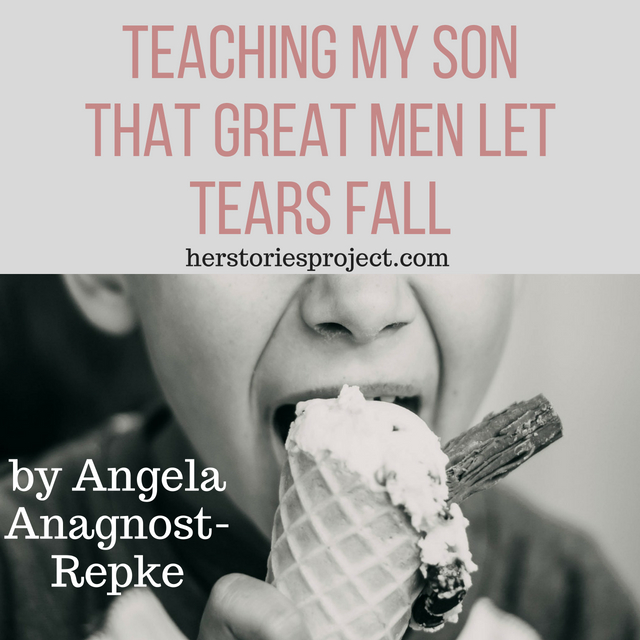
  • Teaching My Son That Great Men Let Tears Fall

     by Angela Anagnost-Repke


    okay to cry

    “Will I cry, Mommy?”

    My son’s voice trembled before getting his three-year-old immunization shots. We sat in the cramped room of the pediatrician’s office—my son, my one-year-old daughter, and me. My son crumpled the paper on the patient bed while I sat in a chair with my daughter in my lap. I prepped him before the well-visit, but knowing that he needed three shots, I was realistic that there would be crying. He had endured numerous check-ups and remembered that they didn’t only include the doctor asking Mommy questions, but also the female aide who pushed the needles into his skin.

    Pressing my pointer finger and thumb together, I said, “It will just feel like a quick pinch. And you’ll be tough.”

    Standing, the male doctor asked all of the typical check-up questions. Near the end, he asked if I had any for him. I did have questions about my son’s speech, but forgot as I brawled with my daughter who pulled down the blinds over and over again. Apparently, she couldn’t read the photocopied sign, “DON’T TOUCH THE BLINDS,” taped to the wall.

    So instead of talking about my son’s speech, I nodded to the doctor, smiled, and whispered “I’m sorry,” every time her chubby fingers dove for the blinds. “That’s okay,” he said. “You’re doing a great job with the kids.”

    “Good enough,” I joked. After the doctor concluded all was well in the well-visit, it was time for the doctor to exit and the aide to enter as a waitress—balancing the small silver tray full of needles with her rubber-gloved hands.

    My son tensed at the sight of the needles. I pretended to be calm—but was dreading the pain he would feel. I stood next to him, my daughter on my hip, with my palm on his back while he sat upright. I didn’t need to hold his hands down. He was ready.
    “Okay, honey. Look up at your mommy,” the aid directed my son.

    He didn’t listen. He steadied his eyes on the needles.

    We watched three rifling rounds plunge into his still-chubby thigh. He clenched his eyes and squeezed his lids shut. After the shots were done, he inhaled a colossal breath and opened his almost-black eyes. His long lashes were dry. Both his body and mine deflated with ease.

     “I’m so proud of you honey,” I said. “You didn’t even cry.”

    And to celebrate my son’s toughness, I took him out for ice cream. He didn’t need to know about his mother’s own need to choke down tears, especially when life seems relentless—piercing shots into your spirit instead of your skin.

    On our drive to the ice cream shop, pride fired out of my pores, ricocheting off all of the car seats. With my right hand at eleven o’clock, I smiled, a truly victorious mother.  Look at me, I thought. I am raising a tough boy—one who doesn’t cry. My son will be just as strong as his uncles, my three brothers. Maybe stronger. Those idiots used to fart into my dad’s old plastic cigar containers and throw “fart bombs” into my bedroom to make me cry. Then one day, the disgusting act stopped making me cry. God, I love them. They never treated me differently as the only girl, making me tough, too—maybe tougher.

    We walked into the ice cream shop holding hands as the sugar perfumed our noses. My kids stood below the counter, their hands smudging the glass while staring at the buckets of ice cream. Oreo, chocolate, vanilla, Superman, Moose Tracks, strawberry, and more. My son was deciding which flavor to choose and whether he wanted a cone or a cup. Tugging at my shirt, he begged, “Stwa-baweeeey! Cone too, Mommy?”

    “Sure, honey,” I said.

    The girl scooping the ice cream was probably twenty and home from college. I couldn’t hold my pride in any longer. “We’re getting ice cream because this boy just had three shots. And he didn’t even cry.”

    “Well,” the ice cream girl replied, “maybe I’ll give this big guy an extra scoop.”

    I paid the girl and we marched outside to sit on the wooden picnic table on a mild Michigan June day. There, my son sat with his pink ice cream cone. His little sister and I shared a chocolate cup. The sun warmed our faces, but didn’t melt our ice cream too fast. My son grinned with a perfect pink ring around his lips. He was happy.

    And at three years old, my son learned that to be strong means that you better not cry. Tough boys get things in life. They get ice cream.

    —-

    Growing up, my Greek alpha-male brothers and I all fought to be the Spartan King—or Queen. There’s never been a clear winner, even today in our thirties and forties. Yet, we were full of love for each other—loud and boisterous. We were there for one another. But the tears, those were scarce.

    When we were younger, our family of six would cram into our 1990 Astro Mini Van and drive south to Myrtle Beach. One day, when I was about eleven, I swam in the ocean alone. The waves’ hands were motioning to me, challenging me saying, “Bring it on, little one.” I accepted.

    My feet planted into the wet sand and the broken shells scratched my feet. As I stepped out deeper, a couple waves smashed over my head, gushing water into my nose. The sting of what felt like Worcestershire sauce in my nostrils burned, but I got back up.

    A monstrous wave came. I turned my back against it, but that wave pulled me under—hard. My right knee slammed into what felt like broken glass. When the wave was done with me, I was able to stand and breathe. I looked down and my knee was gashed—bloody with grains of sand mixed in. But, my eyes were dry.

    I stood proud. And instead of running to my mother crying, I strutted to my brothers. I wanted them to see that as a girl, I could create a bullet-proof vest, too. Like my brothers, no one would ever suspect my vulnerabilities.

    As an adult, I’ve watched my father endure a near life-ending sepsis attack and my mother almost become another number to cancer’s merciless hands. I’ve been with friends and family through tragedies, never crying in their presence. My car served as my personal cry room, only I allowed no one to hush me.

    It wasn’t until recently, months after my son’s immunization shots, that I took off my bullet-proof vest in front of my husband. My mother’s cancer was ravaging her body. And picturing the day I’d call her and she wouldn’t pick up was finally more than I could handle alone.

     My husband turned on the cartoons for the kids. We climbed into our unmade bed, and I finally let someone else’s arms support me. At first, I didn’t know how to do it—to let him see me vulnerable. It felt like trying to parallel park for the first time—seeming impossible and awkward.

     I sunk into my husband, stiff at first. His arms swaddled me and his chest was my pillow. As his fingers stroked my hair, my body softened, and I cried. This was the first time in my life that at five-feet-tall, I felt small. I exhaled relief. Relief that my tense body would not break if it turns gentle. Relief that I didn’t have to endure my mother’s cancer alone. Relief that after eight years of marriage and fifteen years of love, I finally gave all of myself to my husband.

    About a year after my son earned his ice cream trophy and my husband coached me how to cry, a couple of my brothers flew in to celebrate my kids’ fourth and second birthdays. My son and daughter were taking turns jumping off our wooden coffee table onto a giant beanbag in the center of the family room. They love showing off in front of their uncles. My son missed, hitting his knee on a wooden block we failed to pick up. His mouth turned into an upside-down horseshoe, shuddering.

    One of my brothers looked, but sat cemented in his chair. His eyes said, “If you ever want to be a man, you better not cry.”

    My son’s lower eyelids were buckets—heavy with water wanting to spill over the brims. I looked at his eyes and said, “It’s okay to cry.”

    He did.

    Our bodies softened. I went to him, hugging him.

    As I had done hundreds of times as his mother, I cradled him. My brother’s face relaxed and he crawled off of the chair to the floor. With his knees edged into the carpet, he patted my son on the back and said, “You’ll be okay, buddy.”

    In return, my brother looked at me in agreement. Like my husband taught me, I will coach my son that all emotions are okay and crying is necessary. I didn’t have to tell my brother about losing my bullet-proof vest. He understood.

    I want my son to know that it’s okay to cry. In fact, I hope he does.

    The ability to gulp down tears does not make you a man. Being able to express a wide gamut of emotions does.

    I’ll help my son foster these skills. Maybe, with my husband’s continued help, of course, we can encourage our son to express all of his feelings—without shame. He won’t need to follow Spartan Family Code, or society’s Boy Code. Big emotions in men won’t be taboo—not in our house.

    I regret that it took me so many years to exhibit vulnerability to my deserving husband. And honestly, there are times I want to pick my armor up off the floor, but my husband always reminds me to leave it there. So, I hope my son does cry and lets people see it. Being tough isn’t important, but being real is. And to let someone in, to truly let them in, you have to cry.

    That night we celebrated the kids’ birthdays with cake and ice cream. My son spooned the Oreo ice cream into his mouth. He smiled with his uncles—loving him despite the tears.

    Because they too, will help my husband and I teach my son that great men let tears fall. 


    angela repkeAngela Anagnost-Repke is a flawed mother who turns to writing to help in both her daily blunders and rediscovering herself outside of motherhood. She has been published in Good Morning America, ABC News, Scary MommyThe Good Men ProjectMSN LifestyleMothers Always Write, and othersAngela also has an essay in an anthology by Belt Publishing, “Red States, Blue States.” She is passionate about the comradery of motherhood and is an advocate of a moms’ night out. She is at work on a cross-generational memoir, Mothers Lie.

    Keep reading