Month: November 2014

  • Friends in New Places: 5 Tips for Making Friends in a New City

    Making friends in a new city as an adult is never easy. But as we get older, it gets even tougher.

    We may meet new people — at the gym, at kids’ playdates, at work — but it becomes increasingly difficult to turn those acquaintances into friends. Our schedules are packed and less flexible, and our priorities change.

    This month Nina Badzin, our friendship advice columnist, tackles the question of a reader who also faces the challenge of finding friends in an unfamiliar town.
     

    Dear Nina,

    I have several close girlfriends, but not many who live geographically close to me. I had a difficult year last year welcoming a new baby while my husband traveled extensively for work, with little to no family support. I generally come across as a very “on top of things” person, so people often don’t think I need any help. But last year showed me I do need help! As our family plans to move in a few months I want to try to cultivate friendships where it’s not unusual to get together with friends for dinner, or to help one another out. Any tips on how to start from scratch in a new place with that particular goal in mind?

    Thanks,

    Making Friends in a New City


    Dear Making Friends in a New City,

    I love your question and your specific goal! In fact, my answer is on the longer side so it will be the only question we tackle here today.

    No matter the number of friends we talk to on the phone, or via texts, emails, Facebook comments, Tweets, and so on, many of us are wired to see friends face-to-face. Let’s be honest, considering that even a phone conversation can seem rare these days, time together can be that much harder to schedule. As you implied with your question, however, it’s those face-to-face interactions that lead to the kind of friendship where you can rely on others in times of need and joy. Despite what Katherine Rosman reported in the New York Times last week about people who manage to find time for Twitter and Instagram, but can’t be bothered to return a phone call, there are still people who remember that nothing can replace the real connection of hearing a friend’s voice and seeing her face (not on your iPhone screen or in the form of an avatar).

    Fourteen years ago I moved to Minneapolis without any friends. It took me a long time to feel settled, but I eventually made this city my home. I’ve also watched others move here through the years and marveled at how gracefully some transitioned despite the reputation among non-native Minnesotans that it’s impossible to make new friends when “Minnesota Nice” means “Minnesota Ice.” (I’ve also seen less graceful situations, but I’m going to keep it positive.) I’ll share my tips and some ideas from the women who arrived in town more recently.

    I cannot talk about making friends in a new city without mentioning Rachel Bertsche’s memoir MWF Seeking BFF in which she chronicles her systematic effort of going on weekly “friend dates” for her entire first year in Chicago. Like you, Rachel had several close friends in other cities, but she missed having that support system nearby. While going on 52 outings with new friends over the course of a year only makes sense for a book deal, I think anyone can glean lessons from Rachel’s active approach of making friends in a new city, which was: Do not wait for friendships to happen.

    While some people feel annoyed by the word “dating” in reference to making new friends, it is an apt description. Actively looking for quality friends is just like dating, yet in some ways much easier because you can have several friends who fulfill different needs in your life rather than seeking a “perfect” match. I think the biggest key to making new friends in a new city is to accept the fact that she who is interested in new friends is the one who must make the effort. Fight that fact, and you will still be asking this question in five years. Harsh but true.

    1. Making Friends in a New City: If You Feed Them, They Will Come

    Clara* moved to Minneapolis two years ago and she’s already one of my closest friends. She’s managed to achieve what you’re looking for in terms of asking for help and providing help to others. She’s always carpooling with other families to birthday parties, organizing play dates at her house, or sending her kids to someone else’s house. Clara’s willingness to ask for help has influenced those of us in her midst to feel we can ask, too.

    I asked Clara how she settled in so quickly. “Do a lot of hosting,” she said. She hosted dinners and brunches for families from her kids’ classes and her social life grew from there. She didn’t wait for invitations, nor did she feel entitled to tit-for-tat reciprocation. If someone who’d been to her house for a meal reached out to meet for coffee or a walk, Clara considered that invitation a great result from her hosting efforts. She didn’t eliminate women as “friend potential” if they didn’t have her family over right away.

    2. Accept Invitations

    Julie is another newer friend of mine. She moved to Minneapolis a bit after Clara, and she did so without kids. Furthermore, her job gave her no immediate connections to potential friends because she works from home. We met after getting assigned to the same table at a benefit for an organization we both care about, and at some point after that we got together for lunch. (Lunch was Julie’s idea despite the fact that I’m seven years older and a mom of four.) I later invited Julie and her husband for dinner, and some time after that she had the six of us over, too. (Brave!)

    I asked Julie for her number one tip. “Making friends has to be a priority,” she said. Even if she didn’t feel like going out to a particular event, Julie forced herself to go simply for the opportunity to meet someone new or to deepen a connection with an acquaintance. Clara added on the same subject, “If someone wants to set you up with a new friend, always say yes. Worst case and it’s a bad match, it makes for a good story.”

    1. Keep Your Net Wide

    While it’s tempting to look for people who remind you of your long-distance friends, I would keep yourself open to anyone no matter their age and stage in life. (Julie inviting me to lunch is a great example.) That means that if you get an invitation to a family’s house, but they’re much more or less religious than you, have signs in their driveway for candidates you abhor, or don’t seem like “your type,” give them a chance anyway. Instead of worrying “why” you would possibly hit it off with a potential new friend, ask yourself “why not.”

     4. Get Out of Your Comfort Zone

    I recently learned of a friend-making app called Smile Mom from my friend Ellie, who moved to a new city six months ago. Ellie saw another woman post on the app that she was also new to town and had nobody to invite to her two-year-old’s party. This woman was hoping that others would show up to the party she’d planned for her son at the park. Talk about getting out of your comfort zone for all the individuals involved! Even though Ellie’s kids are several years older, Ellie, also brave in this scenario, showed up with a small birthday gift and hit if off with a few of the other woman who also showed up because of the app. I love that in this case technology brought people together instead of allowing everyone to stay behind a screen.

    For MWF Seeking BFF, Rachel took an improv class, started a cooking club, a book club, tried different exercise options, and even asked a waitress who seemed like good friend potential for her phone number. The key here is that she didn’t rely on just one method to make friends. I’d also consider volunteering and even offering to lead committees. It’s a great way to learn more about your new community.

    5. Accept the Reality of The Friend Plate and Chemistry

    There’s no getting around the fact that some people’s friend plates are already too full. I’ve met women new to town as great as Clara and Julie, but I only have so much room in my life for new, close friends at any given time. And of course the issue of chemistry comes to play, too. I think the best policy is to not take things too personally if a relationship does not get beyond the surface. Just keep going and a few friendships will deepen to the level you’re looking for.

    *Names were changed.


    Readers: What advice would you add? Do you know people who excel at making friends in a new city? Have you seen situations where certain tactics haven’t worked at all? Please share!


    Also, remember that our contact form is anonymous. While we have several questions waiting for answers, we are open to more. And your question might even get discussed on the radio!
    Keep reading

  • We Have a Big Announcement!

    We have exciting news, and we are thrilled to finally share it with our HerStories community today! Last week, we signed a contract with She Writes Press to publish our next anthology, Mothering Through the Darkness! We could not be happier about this. Have you heard of She Writes Press? In the publishing world, many people refer to them as a “hybrid publisher.” In their own words, this is how the She Writes team describes their business:

    She Writes Press is unique in the world of publishing because we’re neither traditional publishing, nor are we self-publishing. We have begun to bill ourselves as a “third way” and we proudly occupy the gray zone, a much-needed alternative in a rapidly changing publishing landscape.”

    She Writes is an independent publishing company that gives writers more control than a traditional publisher; they provide high-quality services as well as a positive community experience.

    Jessica and I have had a great experience with self-publishing our first two books; we particularly found our groove with My Other Ex. But we are very much looking forward to publishing with She Writes—from working with their cover designer, to their editing team, to being part of a community that helps promote women writers and their work.

    For more information on She Writes Press, their services, and how to submit your manuscript to them for consideration, visit their website. Right now, our book is slated for publication in fall 2015! We are so excited; we’ve been steadily receiving submissions, and we look forward to receiving more in the coming weeks. If you’re thinking about submitting an essay but you’ve been on the fence, we hope you’ll take the plunge.

    On that note, we are happy to share that we will be extending our deadline for our call for submissions and writing contest for Mothering Through the Darkness. The deadline for submissions is now January 1st, 2015. For more information on the anthology, the guidelines, the contest, and how to submit, read this post. And you can submit your essay directly by following this link.

    callforsubmissMTD


    Subscribe to our newsletter to continue receiving updates about our project and our partnership with She Writes Press!

    Keep reading

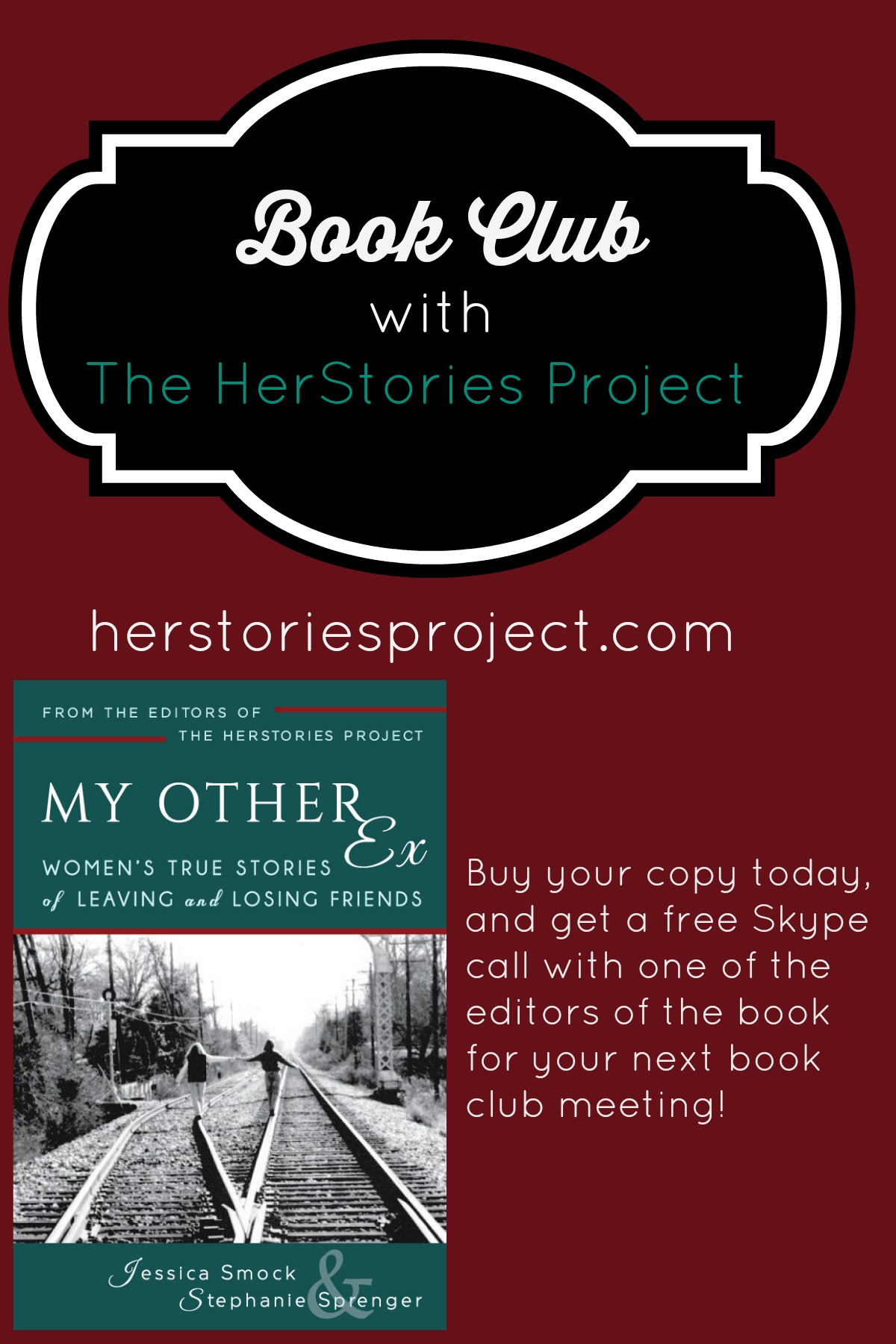
  • Book Club With The HerStories Project

    Are you in a book club? Book clubs aren’t always quite as easy or fun as they sound; even our own advice columnist, Nina Badzin, has struggled with book club drama! Some book clubs run into trouble when members disagree about the “terms” (you know, whether or not your group actually reads the book or whether they just sit around and drink wine and talk about their kids), and some book clubs can’t seem to agree on a book that interests all of them. I’m embarrassed to say that every single book club I’ve ever been part of (three!) has dissolved for one reason or another.

    But maybe you are one of the lucky ones and you have the perfect book club. Now all you need is the perfect book! (Do you see where I’m going with this one?) Not surprisingly, we think My Other Ex: Women’s True Stories of Leaving and Losing Friends would make a fantastic book club book. Here are just a few reasons why:

    1. Essay collections make for an easy, enjoyable read: you can put the book down and pick it up as often as you like, reading a whole section of the book in one sitting or just an essay or two at a time.
    2. These stories are real, which makes them even more compelling and relatable. We think you’ll find yourself somewhere in these essays, if not over and over again throughout the book.
    3. Friendship breakups and loss are universal; everyone can relate to the loss of a close friendship, whether it occurred recently or many years ago, and whether you were the one who was left behind or you did the walking. Reading about the friendship endings of others is sure to stir up some memories and feelings, and that makes excellent fodder for book club conversation.
    4. You might actually experience some relief, a catharsis, or an “aha” moment by talking about friendship loss with other women. One of my best friend’s husbands always says, “Have fun at therapy!” whenever we get together. It’s true: women gathering together and talking about the richness, complexity, and pain of relationships can be extremely therapeutic.

    And if that’s not enough to convince you, we have one more fun reason why we think My Other Ex would make a great choice for your book club. If your book club decides to read and discuss My Other Ex for its next meeting, you can have a complimentary Skype call with one of the editors! During your book club meeting, either Jessica or I (Stephanie) will be available for a Skype call where members of your group can ask us questions about the book, the publishing process, the essays, or friendship breakups in general. We already have one lined up, and we think it’s going to be so much fun! Send us an email at info@herstoriesproject.com if you’re interested in setting up a chat for your book club meeting! You can buy the book here, and we’re including some Discussion Questions below to get you thinking:

    book club HSP

    Book Club Discussion Questions for My Other Ex

    • How old were you when you experienced your first friendship breakup? Who ended it? Did it take a long time to recover?
    • Have you had many friendships end? Did they fade away or were the breakups more dramatic?
    • When was the most recent time a friendship with a close friend ended? How did you feel?
    • Have you ever broken up with a friend? Why? Did you feel guilty?
    • Has a friend ever badly hurt you by ending your relationship?
    • Have you ever had a friendship end unexpectedly? Was it more painful than a gradual ending? Why?
    • Have you ever had a friendship end because of a romantic relationship? Did you lose friends after a divorce (yours or a friend’s) or after ending a romantic relationship?
    • Have your friendship breakups affected other friends in your circle? Did people have to take sides? Have you ever been “left behind” when your friends chose another friend over you?
    • What do you wish you’d done differently in the breakup? What do you wish your friend had done differently?
    • What would you say to your friend now, if you could?
    • Did you ever have a friendship end and it brought you relief?
    • Have you broken up with a close friend only to reconnect later? How did it change your friendship?
    • Do you think friendship breakups are more or less painful than a romantic relationship ending? Why?


    We would love to hear your reactions to the book! If you’ve read it, please consider writing a review on Amazon– it means a lot to us! And please spread the word to other book clubs you know! Happy reading!

    Connect with us! Are you signed up for our newsletter yet? Sign up in the sidebar to keep up to date on all our news and announcements. (Spoiler alert: We have a big one coming on Monday!) You can also find us on Facebook and Twitter.

    Keep reading

  • My Other Ex Contributors Dish About Their Essays and New Projects

    It’s been more than a month since My Other Ex released! Recently we asked our contributors to reflect on the experience of writing, editing, and submitting their essays, as well as becoming a part of the HerStories Project community and their future projects.

    MYOTHEREX1


    How long did it take you to write and edit your essay for My Other Ex? Did you receive any feedback on it before you submitted it?

    Elline Lipkin: About three weeks.  Got great feedback from a local writing group I belong to.

    Alyson Herzig: It took me about a month and I worked with a professional editor.

    Katrina Willis: I wrote the essay in an afternoon and tweaked it for about a week or so. I didn’t let anyone read it before I submitted, and I didn’t tell anyone that I had submitted — not even my husband.

    Jennifer Simon: Maybe 3 months? My husband and two writer friends all read and edited it.

    Alethea Kehas: Not too long, since I adapted it from my memoir manuscript. It underwent some editing in the earlier stages.

    Did you have any concerns about privacy, about protecting the identity of the characters in your essay, and about your essay affecting your present relationships? If so, how did you deal with your concerns?

    Shannan Younger: I did, and while I had a few different friendships in mind to write about, I selected the one that would least impact present relationships. I did feel like I should tell my subject that I wrote about her, but my efforts to find her have been unsuccessful.

    Katrina Willis: I wasn’t concerned about privacy. As a blogger, my life is pretty public, anyway. But my former friend and I do have mutual friends, and I was concerned about their reactions. My intent was not to defame, but to present my own feelings, my own viewpoint. I fully understand and respect that she has hers, too.

    Estelle Erasmus: No. [My friend] Laura was involved every step of the way. I even changed some of the sentences based on her input.

    Alison Lee: Yes, because I reconciled with the friend I wrote about. I asked her first if it was alright if I shared our story (she’d read the blog post I wrote), and she said, yes, go ahead! She also read the final draft before I sent it in for submission. I did change her name.

    Other than your own, which essay resonated with you most deeply? Why?

    Shannan Younger: Alethea Kehas’ story of tween struggles may have struck a chord with me both because of my experiences and because my daughter is in junior high now and I write about tween issues. She captured the pain that tween girls can cause each other, and it made me think about her mother, too, in terms of both what Althea did and did not share with her and her reaction. It hit home on multiple levels.

    Estelle Erasmus: I would say Alexandra Rosas’ because she just wouldn’t get that the woman didn’t want any kind of deep friendship with her. She was lonely and I remember being so lonely in the beginning of motherhood when I hadn’t yet formed any kind of community. It was hard and I could definitely see my feelings leading to that kind of desperation. I actually grabbed a guy who had a baby girl my daughter’s age in the elevator of my building and asked (or was that demanded ) for  him to have his wife call me. She was my first mom friend and my story is a happy one. Although she has moved away, we are still friends to this day.

    Alyson Herzig: “Girls Interrupted” by Alexis Calabrese touched me deeply. Having a son with autism has taught me that many people don’t know what to say or do. For years others fell by the wayside leaving him and us looking in. I felt her pain when she realized that her friend had diminished her child and his life through the heartless play her husband had put on. Her friend Erika’s lack of understanding and compassion resonated with me, because I have lived that life. I live that life now.

    Sandy Ebner: Each of the essays touched me deeply so it’s very difficult to single out just one. However, Alison Lee’s, “The Internet Breakup” really hit home for me because I’m going through something very similar to what she describes in her essay.

    Katie Sluiter: Oh gosh. This is a hard choice. I am going to pick Arneyba Herndon’s because I laughed and got angry while I read it. I mean, if I was there, I would have at LEAST saved her sandwich for her!

    Lea Grover: I think “Delilah.” The narrator was very much me, at the beginning of middle school. Unlike the Delilah of the story, though, my friend became incredibly abusive, and dominated my life for years. That story broke my heart, because there were so many times I wish I’d just disappeared and broken our friendship instead of sticking around, and the sense of regret in there about doing it kind of healed something in me that’s been broken for a long time.

    What have you enjoyed most about being a part of this anthology?

    Elline Lipkin: The incredible community online.

    Shannan Younger: My favorite part has been hearing the stories from contributors of how they have heard from friends and sometimes reconnected, of being reminded that people change and that there’s hope for some people on whom we have given up.

    Estelle Erasmus: The leadership of the editorial team, Jessica and Stephanie. They have gracefully and graciously navigated us through the publishing journey with them and in the process we have met and befriended each other.

    Alison Lee: Everything. The thrill of seeing my name in print, of being part of the project alongside 34 other amazing writers and two incredible editors. Reading the reviews has been wonderful, learning about the reviewer’s stories and their thoughts about friendship. I’m just so proud to be part of this anthology.

    Alexandra Rosas: Being able to no longer carry my story inside of me. I felt freed.

    Sue Fagalde Lick: The sisterhood that has developed among the writers.

    Alyson Herzig: The interaction with so many wonderful and amazing ladies that are outside my normal genre. I have been humbled by the credentials of the others. I have also been enjoying the camaraderie.

    Lea Grover: Realizing that there is a much higher standard I should be holding myself to as a writer, and aspiring to do that.

    Katie Sluiter: Other than the fact that I now have my own author page on Amazon, I have really loved the new connections I’ve made with the contributors. We are all pretty diverse, but this one thing – losing friends – has brought us together. It’s a pretty cool thing.

    What is your advice to other writers who hope to get published in anthologies?

    Alyson Herzig: Even if it is not your normal genre you should submit. Let your readers see all the many facets of you, not just one. It expands your base and builds a solidarity with a group of women that you most likely would not have had otherwise.

    Kristin Shaw: Try, and try, and try again.  First, polish your work before it’s submitted – it’s hard to see the mistakes in your own essay, and you become melded to the words you have created without looking at them objectively. It’s important to find a few editors you trust to give you honest improvement suggestions.

    Victoria Fedden: Look for calls for submissions that speak to your experiences. Then try to imagine what the most common submissions will read like and be about and write the total opposite so that your piece stands out. Any way that you can be original or unique or find a new perspective on the topic will better your chances.

    Alison Lee: Write and submit. In writing your story, stay true to your voice. Edit brutally. Ask for feedback and be prepared to take any criticism, because they’re there to help you. Then submit. Don’t think that your writing or story isn’t good enough.

    What are your current and future writing projects?

    Elline Lipkin: I’d love to write both essays and more reported pieces for sites like the Atlantic and Slate (dreaming here!) about things/topics that affect women and girls.

    Estelle Erasmus: I am working on getting some of my essays published that have been taking space in my laptop for years. I sort of put stuff on hold in the early years of motherhood, but now it’s time to take everything off the back burner and begin again. I was thrilled to be published on Marie Claire and that is just the start for me. I’ve also reconnected with some publishing mentors from my early career and I’m excited to see where that will lead.

    Alyson Herzig: I am working on my Mental Healthy anthology, having just gone through all the submissions. It will be published in 2015.

    Kristin Shaw: One of my essays will be featured in Bannerwing Book’s Precipice anthology in October, and I have written two chapters for Carolyn Savage’s new book series (she is an author and Today show correspondent) that will be released early next year.  I have written a children’s book with Kelly and Rick Dale from the History show American Restoration, and we’re hoping it will go to print later this year.

    Katrina Willis: I just finished my next novel, tentatively titled “Parting Gifts.”

    Sandy Ebner: I’m working on a short story about a Vietnam vet, and am getting ready to start a revision on the novel I’ve been working on for what seems like forever. I’d also like to do a collection of essays.

    Lea Grover: I’m querying a memoir, and I’m working on an erotic fantasy e-book series. It’s AWFUL.

    Victoria Fedden: I just finished a piece about postpartum depression and OCD and I am about to embark on my third memoir.

    Jennifer Simon: I am publishing articles on various websites and working on my piece for the new anthology!

    Alison Lee: I just had twins at 34 weeks, and I have many thoughts and emotions about our time in NICU. I plan to write a series of essays on this, as well as general experience with twins (and four kids!). I’m also keeping an eye out on future anthologies and other writing opportunities at various websites and magazines. I’d love to be published again!

    Alethea Kehas: I’m working on some poetry and a Y/A book that would probably be in the category of Fantasy.

    Katie Sluiter: I just submitted an article on using mental health issues in a secondary classroom (I’m an English teacher) to a scholarly journal. I am also working on an essay for the HerStories Project’s next anthology about Postpartum Mood Disorders.  And I’m always writing alongside my students. Since they will soon be writing personal narratives, I have started my drafts so they can use them as mentor texts as they start their drafting processes.

    Alexandra Rosas: Hoping to have my collection of 35 short stories published under cultural memoir/Latina heritage.

    Sue Fagalde Lick: I’m marketing a novel and working on a memoir about the years I cared for my husband through Alzheimer’s disease.

    Do you have any questions for any of our contributors about their writing and submitting experiences?


    Keep reading