
Month: August 2014

  • Teaching Our Daughters About Friendship Breakups

    “Mommy, Olivia and Claire are sitting right over there!” my seven-year-old daughter announced excitedly, tugging my arm. “Let’s go talk to them!”

    I shot a pained glance at my girlfriend, seated across the table from me, and sighed. “Honey, Mommy is not going to go say hi to Olivia today.” My daughter looked confused. When we had made plans to meet friends for pizza that evening, it hadn’t occurred to me to be prepared for this conversation. Why would I expect them to be here? Perhaps I’d hoped I could entirely avoid ever bringing this up with my oldest daughter.

    Taking a deep breath, I explained, “Mommy and Olivia had a fight. We aren’t friends anymore, and I’m not going to go talk to her. But you are welcome to go say hello—I know Claire would love to see you.”

    “But why aren’t you friends anymore? Why did you have a fight?” my daughter persisted.

    “Honey, that’s a grown-up problem and I’m not going to explain it to you right now. But I do want you to know that just because Olivia and I aren’t friends, it doesn’t mean that you can’t be friends with her, and with Claire.”

    “Can Sophie and Claire still be friends?” she inquired, referring to her toddler sister.

    “Of course,” I lied, having a slightly deeper understanding of the parentally-directed social practices of the under-two-year-old crowd.

    She trotted away happily to greet themand I exchanged glances and sighs of relief with my girlfriend, the third side of the friendship triangle gone wrong. Olivia and I hadn’t drifted apart. To say that we had fought was not an exaggeration—it was an ugly, uncomfortable blowout that had bled into other relationships and had even affected my job. It was awful, and I was never, ever going to be friends with her again. So how did I expect my second grade daughter to grasp such intricacies? Especially when I repeatedly coached her to mend fences when she and her own friends had argued?

    My daughter was no stranger to friendship drama; sadly, even in kindergarten she had struggled with unkind friends, gossip, rumors, and the ever-awkward dynamic of three little girls attempting to play together. I knew she had years ahead of her filled with hurt feelings, exclusion, arguments, lies, and eventual breakups. But what I wasn’t sure of was how to begin teaching her about the realities of those inevitable hurdles and subsequent friendship loss. As I reflected on the many conversations we’d had about friendship, I realized we had already covered a lot of ground about how to navigate social challenges.
    Friendship Breakups


    • Openly share your own childhood friendship stories—this is so important to little girls. My daughter loves to hear me share my own tales of trying to balance my friendships with my two best friends who didn’t get along with each other, birthday parties gone wrong, and what happened when the “new girl” came to town and took away my best friend. Knowing that I too had problems, and more importantly, that I overcame them, helps my daughter to feel less alone. As you discuss your own experiences of hurt, anger, and loneliness, you become a more reliable confidante—when children sense that their parents can genuinely empathize, they are more likely to share their feelings, and more likely to listen to your advice.
    • Listen without judgment when your daughter tells you about the friend who wronged her. Whenever my daughter shares a story about an alleged mean friend, I am always tempted to jump in and point out contrary pieces of evidence, offer a solution, or even get angry and “feel her feelings” for her. Women often get irritated when, instead of listening, their husbands try to “fix” their problems—it’s the same with our daughters. Before we can help them sort through their friendship problems, they have to feel heard. Reflecting feelings back to our children often helps them to sort through their complicated emotions.
    • Role play with them. My oldest child loves this, and it has been a positive tool ever since she was in preschool. Whenever she would struggle with a friend who was being mean, rude, or (gasp) bossy, we would practice what we wanted to say to the friend. We took turns playing each role, which helped prepare my daughter for potential retorts and responses. It was so empowering for her to find her voice, her confidence, and stand up for herself, even if that meant walking away from a friend. As she gets older, she may want to involve me less and less in her role-playing, but I’d like to believe that she is developing skills to assert herself, set clear boundaries, and articulate her needs—those skills can last a lifetime.
    • Help her find out when it is time to walk away. Throughout the past few years, my daughter and I have had numerous conversations about one friend in particular; these two girls have split up and come back together too many times for me to count. It is painful for me to refrain from shouting, “Kelly is not a nice friend! You should not put up with this kind of treatment!” I’m afraid the same rules apply to both friendships and boyfriends: often, if a child senses her parent disapproves, it only makes her more determined to make the relationship work. I am mindful not to vilify her pals, but I am very firm and clear when I discuss with my daughter what type of friendship behavior is unacceptable and not to be tolerated. I have had the most success with helping her focus on other friends rather than “banishing” the unkind friend; encouraging my daughter to pursue new friendships has been the most effective way to help steer her away from girls who repeatedly hurt her.
    • And help her cope when someone has walked away from her. Rejection, perceived disapproval, and alienation are extremely powerful and painful experiences for young girls and teens. OK, fine, and for adults, too. Many women carry the pain of an unwanted friendship breakup for years. Remind your daughter of her strengths, of the qualities that make her beautiful and unique. In many ways, losing a best friend is just as painful as losing a romantic partner, an experience that will likely happen multiple times throughout her life; it helps to reinforce the fact that not all relationships were meant to last forever. Help her to reflect on the fun times that were had, the lessons that were learned, and focus her attention on other positive forces and friendships in her life. This is another time when it helps to share your own stories of loss and friendships gone wrong—tell your daughter how you felt, why it hurt, and most importantly, how you got through it. She may not fully understand it for years to come, but you can help to share your perspective that friendships ebb and flow as we grow and change.
    • Teach her when—and why, and how— to stick around and fight for a friendship. Sometimes it may be your daughter who has wronged a friend. One afternoon at the bus stop, my daughter tearfully told me that she and her best friend weren’t friends anymore. She then confessed that she had shared a secret—she had told another friend the name of her BFF’s crush. This is tantamount to ultimate betrayal in second grade. I was chagrined. My daughter felt deeply ashamed, and I convinced her that she had to make things right with her friend. It is humbling to apologize and admit when you were wrong—for children and adults alike. These perceived betrayals will only get more complex as our daughters get older, and as their mothers, we can help them find the clarity they need to make things right when a friendship is worth fighting for. We can help them brainstorm ideas, write apology letters, and support them as they apologize to friends; we can also stand by their side as they find the courage to confront friends who have hurt them, intentionally or unintentionally.
    motherdaughter

    There are myriad resources available to couples who are looking for help to save a broken relationship, but there seems to be a distinct lack of support for women (or men) who want to fix a troubled friendship. While most people (theoretically) practice monogamy in their romantic relationships, the same concept does not apply to friendships, which perhaps sends a message that friends are expendable and easily replaced. However, much like romantic relationships, finding a new partner doesn’t always mean that unhealthy patterns have been broken, and the same problems often play out again and again. Teaching our daughters about friendship is both complex and essential. As mothers, we can give our daughters the emotional and communicative tools to repair damaged friendships, identify when they need to assert themselves, and help them cope with the pain of loss.
     

    Keep reading

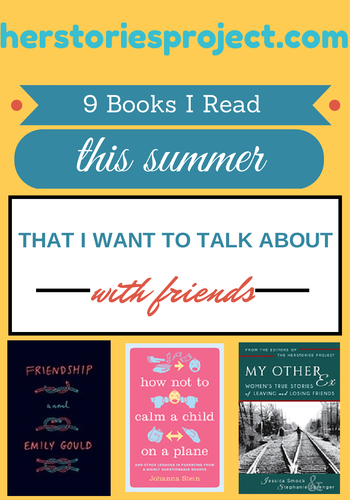
  • 9 Books I Read This Summer That I Want To Talk About With Girlfriends

    9 Books I Read

    As a true introvert, reading has never been that much of a social activity for me. And that’s basically what I’ve always liked about it. Since I was a little girl, I loved entering a different world  — ALONE! — and meeting new characters and understanding their struggles.

    As a kid, I don’t remember having any burning desire to talk about Laura Ingalls Wilder’s pioneer adventures, about why I loved Narnia, or even later my predictions for the next high school romance for the twins of Sweet Valley High. I exchanged books with my friends but we didn’t talk about them much.

    Later I made half-hearted attempts at trying to become more social with my reading. I joined a book club or two and never returned after my first meeting. (Like my friend Nina Badzin, I became frustrated with the way that these book clubs never seemed to get around to talking about the actual book!) I even started my own book club at work once. I tried GoodReads. I went to a few city-sponsored book discussion groups. I even watched Oprah when she featured books that I had read.

    But all of this talking was never for me.

    Then I started blogging and I discovered that I did like talking about books… just not in person. I love having conversations online about books — with my real life friends, with my blogging friends, with other writer friends. The “conversations” are specific and focused; they don’t tend to get side-tracked by comments about the delicious appetizer being served.

    Now I find that if I’ve read a book that I’ve loved, the experience is not complete without “talking” about it with someone: on Facebook, Twitter, in our Brilliant Book Club for Parents, on blogs.

    This summer I haven’t written much about books. Pregnancy, the impending publication of the new HerStories Project book… they’ve all gotten in the way, and I miss sharing my latest reads.

    Here are the books that I read this summer about which I wish I’d had more conversation (online, of course):

    1. I Am Having So Much Fun Here Without You by Courtney Maum. I absolutely loved this novel. It’s narrated by a married guy with a young daughter who’s ended a passionate affair but wants to win back his ambivalent wife. It’s mostly set in France and got me thinking a lot about the idea of monogamy.

    My thoughts: I found myself increasingly sympathetic to this unfaithful husband. Is that a weird response?

    2. Friendship: A Novel by Emily Gould and 3. My Salinger Year by Joanna Rakoff. I’ve already reviewed Friendship, and I’m putting these together because they reminded me of a life that I always fantasized about: living in NYC as a writer/editor in my twenties. My Salinger Year is a actually a coming-of-age memoir about Rakoff’s experiences as an assistant to the literary agent of J.D. Salinger.

    My thoughts: As a writer intrigued by the publishing industry, I loved both of these books. But do you think there are too many books, too many movies and TV shows, about privileged twentysomethings in Manhattan who want to become writers?

    4. Cutting Teeth: A Novel by Julia Fierro. I’ve been a huge fan of this book since it came out as well. It’s about a group of NYC parents (all of whom have serious — and not so serious — issues) who go away for a weekend on Long Island. It’s about the anxieties of frantic modern parenthood, the difficulties of negotiating friendships and alliances with young kids. It’s funny, biting, honest, sad, and touching, all at once.


    My thoughts: How much can you identify with these characters, or did you read the novel as more of a social critique?

    5. All Fall Down: A Novel by Jennifer Weiner. I didn’t love this book as much as I’ve liked some of her other novels. Still I was fascinated by the portrait of addiction that Weiner paints. I knew very little about prescription pain medicine abuse, and I did find myself wondering if I knew anyone who might be suffering.

    My thoughts: Did Weiner’s portrayal of Allison’s coping strategies and descent into addiction seem realistic to you?

    6. Remember Me Like This: A Novel by Bret Anthony Johnston. The plot sounds like this could be an edge-of-your-seat thriller, and if you buy it believing that, you might be disappointed. It’s actually a beautiful, luminous literary novel, nearly disguised as a movie-of-the-week story. It’s about what happens when an abducted child miraculously returns, when happy endings and recovery are more complicated than a newspaper headline.

    My thoughts: The book reveals little about the boy’s time during his abduction. Do you think the author was smart to leave out those details?

    7. The Arsonist: A novel by Sue Miller. I would read anything that Sue Miller writes — her shopping list, a few scribbles on the page. For me, this novel — about a fortysomething African aid worker who returns home to small town New Hampshire just when a series of arsons wreak havoc on her town — did not disappoint.

    My thoughts: Who are the writers that you will always read?

    8. How Not to Calm a Child on a Plane: And Other Lessons in Parenting from a Highly Questionable Source by Johanna Stein. Parenting humor memoirs are not really my thing. I received a review copy of this, and I was surprised to find it incredibly entertaining. I love Stein’s fearless sense of humor and her not-so-serious attitude about parenting. She’s a terrific storyteller.
    My thoughts: I find it impossible to write humor as good as this. What are the keys to be being funny and wise when writing about parenting?

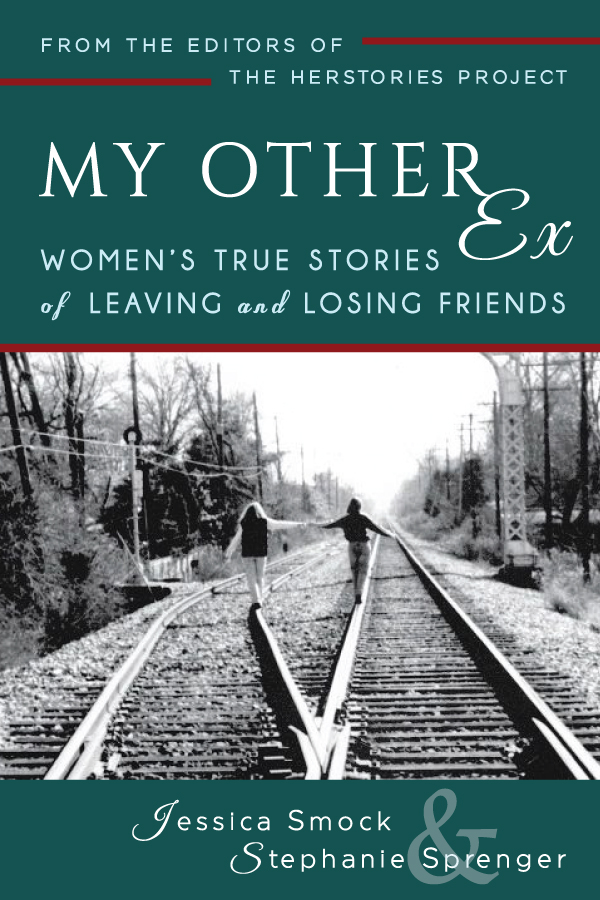
    9. My Other Ex: Women’s True Stories of Losing and Leaving Friends. Why, yes, it is our about-to-be-released HerStories Project book. But it’s also much of what I’ve been reading this summer, and I can’t wait until everyone gets to read these compelling and fantastic essays. I can’t wait to see which ones you can relate to and which ones make you laugh, cry, or think about friendship loss in a new way!

    My-Other-Ex-final-3

    The official release date is September 15th, when it will be available on Amazon, Barnes and Noble, as well as on our website as a download.

    What are some books that you read this summer that you really want to talk about? 

    Keep reading

  • Why Men and Women Handle Friendship Conflicts Differently

    Have you ever thought about how differently men and women approach their friendships, and more notably, how differently they handle friendship conflicts? My Other Ex contributor Shannan Younger asks the question, “What would a male version of My Other Ex look like?”

    Men and women often have disparate approaches in many areas of life, so it is unsurprising that they approach friendships and the conflicts that come with them differently, too.

    My husband and I are perfect examples of some of the ways the genders diverge when it comes to friends. He says that I need to see my girlfriends in a way that he does not need to see his buddies, and he’s right.

    In addition, I come home from an outing with friends with information about their marriages, issues with co-workers, and the scoop on recent life changes. I get the scoop. When it comes to his friends, he gets pretty much nothing.

    When I ask him for the latest gossip from his friends, he looks at me blankly. Turns out, he’s not unique.

    “I’ve played poker with the same guys every Thursday night for 18 years. We rarely talk about our lives. We talk about cards, betting, bluffing,” wrote the late Jeffrey Zaslow, author of The Girls from Ames, a book about female friendship, in the Wall Street Journal.  He asked his poker buddies if they knew his children’s names. They did not.

    The varied approaches my husband and I have to friends recently became very apparent when I received an invitation from a new friend. I angsted aloud about the etiquette surrounding the event, whether my friend felt obligated to include me, and the importance of giving her an out if that was the case, but also needing to do so in a way that made it clear I truly appreciated being included. I made a big, hairy deal out of something simple.

    My husband let me go on for a while and then quietly said, almost to himself, “I don’t get how hanging out with your friend is hard. Guys don’t do this.”

    While my own issues contributed to the drama, it illustrates how men and women experience friendship from differing perspectives and with separate goals. It also shows that sometimes women generate internal conflict that men do not.

    The fact that I mentioned none of my concerns to my friend also illustrates my tendency to keep concerns to myself. In talking about friendship break-ups with other friends, the inability or failure to speak up and air worries, and particularly grievances, is a common thread.

    Admittedly, in that instance I was making friendship hard work when it didn’t need to be. (Side note: I shelved the drama, accepted the invitation, and had a lovely time.) And there are times when I would argue that my husband isn’t working hard enough on his friendships.

    I certainly wouldn’t be the first female to think that men aren’t as good at friendship as women.

    It turns out that there is research to back up that hunch. Men reported interpersonal competition and lower friendship satisfaction in a 2007 study at the College of the Holy Cross. The interpersonal competition indicates a one-upsmanship

    That interpersonal competition may be more prominent in male friendships because men favor side-by-side friendships that allow them to participate in activities together, often athletic activities that are literally competitions. Women, on the other hand, often prefer friendships that are face-to-face so that they can share, exchange and bond with each other, while, according to Dr. Irene Levine, a psychologist, friendship expert and author of the book Best Friends Forever: Surviving a Breakup with Your Best Friend.

    It is also possible that men are more tolerant of their friends, leading to less overall conflict. One study of female college students requested a change in roommates far more often than males, which researchers attributed to men being more accepting of their friends’ failings. That, in turn, leads to less conflict.  They also noted that one possible explanation “could be that women value the friendships more, and so are harsher judges when they perceive a betrayal.”

    There are, however, similarities between male and female friendships.  Men and women both invest in their friends and value time spent with them, as Wood noted in her book, although they spend that time in very different ways.

    Experts agree that both genders derive support from their friends.  Studies have shown that friendship is beneficial to the health of both genders, including this one out of Brigham Young University in 2010 that found that the quality and quantity of individuals’ social relationships has been linked not only to mental health but also to both morbidity and mortality.

    Neither gender has a lock on conflict-free friendship. Issues invariably do arise in male and female friendships. Along those lines, the end of friendships is not specific to women.

    Both genders feel pain at the loss of a friendship. Daniel Duane detailed the pain and frustration he felt when his best friend drifted away after moving to another state in his piece “Do Men Suck at Friendship?” in Men’s Journal.  He even told his friend, “I’m hurt!” While I may not have approached the conflict in the same way, I absolutely related to his experience and found his account was moving.

    Thinking of Duane’s story of his friendship breakup, and how men and women differ in their approaches to friendship and conflict with friends, makes me wonder what a male version of My Other Ex would be like.


    ShannanYoungerHeadshotShannan Ball Younger is a freelance writer and blogger living outside Chicago with her husband and daughter. She’s originally from Ohio and received her undergraduate and law degrees from the University of Notre Dame. She blogs at Mom Factually and at Chicago Parent. You can also find her writing in the book The Her Stories Project: Women Explore the Joy, Pain and Power of Female Friendship and several regional publications.

    She has written about the adventures of raising an adolescent at Tween Us on ChicagoNow for more than two years, so it’s probably not a coincidence, then, that her essay in this collection is about a friend with whom she was close in middle school.

    Keep reading

  • You’ve Got a Friend in Me

    We are excited to share a guest post today from My Other Ex contributor Leah Vidal. I got the pleasure of meeting Leah in person at the BlogHer conference in July, and she is just as warm, dynamic, and inspiring in person as she is on the page. I think you’ll love this powerful post from Leah about teaching her twelve-year-old daughter about friendship, social circles, and self-worth. ~Stephanie

    I hope I find friends who like the same things I like. What if no one likes Dr. Who or Sherlock Holmes, the BBC version of course, or art or reading the same books I read? What if no one knows who Loki is or Tom Hiddleston or that Benedict Cumberbatch plays the role of Sherlock better than anyone in Sherlock Holmes history?”

    The questions tumbled from her lips like drops from the sky, raining down on me, covering me in a film of indecision.

    I looked at my twelve-year-old daughter who took her last school by storm in her knee-high rainbow socks and high top Converse, who wore her hair naturally curly no matter how many people offered to straighten it for her and was struck by the fact that all she hoped for was finding people whom she could connect to on a deeper level. She wasn’t worried about what others would be wearing, even though this will be her first time in a public school with no uniforms. She wasn’t worried about her hair or her weight or wearing the “right outfit” the first day of school.

     I allowed myself to just sit and be proud of her for a moment and collected my thoughts before responding to her, knowing she would hang on my every word as she so often does when she’s troubled, as though each piece of wisdom I share is wrapped in gold, shiny and promising, and worth its weight in…well, gold.

    I tried to remember what it was like at her age, when kids grouped together based on athletics, academics, arts, etc. I tried to remember what it felt like to stand amidst one group, while longingly looking at another knowing in my heart of hearts that I would only ever experience them from afar. I tried to remember why we felt it was so important to remain within our separate, little circles instead of letting them merge and overlap, allowing each individual to share their unique personality and interests with others all the while making us each better just by interacting. Why was it imminent that we only allow ourselves to be ourselves within the safety of one group when we had so much to offer each other – not to mention so much to learn from others?

    I’ve always told my children with every one of our moves that they only need one good friend to make it feel like home. And, I still believe that with all my heart. However, I also believe that we become so much more when we put ourselves out there and interact with people whom we can’t imagine having anything in common with and grow tremendously from the simple act of reaching out, or letting someone new into our circle of one.

    So, I shared these exact thoughts with my daughter, but there was still more I wanted to say. I’m not sure she’s old enough to really get this yet, but maybe she’ll find herself remembering some of it at some point this year or next and suddenly she’ll get it, really get it. So, while I had her undivided attention I said:

    “Know that these groups, these circles, these labels that are the end all be all at your age won’t matter at all as you get older. As time passes and you live, truly live, you will be surprised by the friends that surround you. You will understand that you don’t need to share the same interests to be friends because friendship is so much more than watching the same TV show or enjoying the same book. You will have those friends and share a laugh over a movie quote from time to time, but you will also find yourself learning more about you, the real you, from those that you have nothing in common with because they are the ones who will bring new things to light, who will spark your interest in something new, who will help you grow in ways you never thought possible.

    So, as you go about your first weeks in a new school embrace those who reach out to you even if they may not be familiar with your interests and more importantly be that person for others. Do not feel like you have to give up a part of you to be accepted or make friends. You are enough. Your differences may just be what helps someone else grow. More importantly, as you navigate your way through the ups and downs of friendship that will undoubtedly come at your age, know that you have a friend in me.

    Always.

    I also covered her mirror with these motivating stickers so she’s reminded on a daily basis that she’s amazing just the way she is and that she’s enough.

    im-enough2-2

    28dff04a-21c7-4d3d-aed4-6f76a66cfaf9

    Leah Vidal, author of Red Circle Days and writer at Little Miss Wordy explores BIG lessons from life’s little moments —those that plant the thought provoking seed of self discovery. She believes it is these moments that are life’s biggest lessons. Leah is a 2014 BlogHer Voice Of The Year and her writing has been syndicated on BlogHer, featured on the Erma Bombeck site, Freshly Pressed on WordPress and highlighted on Fitness and Parenting sites. She has been featured on PubSlush Women Of Wednesday and is currently working on her second book.

    Keep reading

  • Forty, Pregnant, and Failing at Friendship?


    The term “geriatric pregnancy” no longer makes me wince.

    Neither does the “AMA” (advanced maternal age) stamped on my chart at my OB/GYN’s office. I no longer panic when I read about all the increased risks of pregnancy among the “older” set: chromosomal abnormalities, stillbirth, pre-term labor, gestational diabetes, and on and on. My doctors don’t seem to find my pregnancy to be in any way remarkable so I’m trying not to either.

    First days of "geriatric" motherhood
    First days of “geriatric” motherhood

    I was 36 when my three year old son was born, and I’ll be 40 this fall when this baby (a girl!) is born. I don’t feel like an old mom, but then again I have no idea what it feels like to be a young mom. Compared to my last pregnancy, I need more sleep at night, get more tired during the day, have more leg cramps and leg pain, am more irritable, had worse morning sickness during the first trimester, and feel generally more uncomfortable. Is all of this because I’m older now? Or are these  just the inevitable side effects of raising a toddler while pregnant?

    If the physical aspects of pregnancy at 40 have been relatively easy and predictable, I’m having a little more trouble coming to terms with the social and psychological dimensions. As a younger adult, I never imagined myself adding to my family at 40. During my first years of teaching, I taught with a woman who had her first and only two children in her forties. I remember how strange that seemed to me. In my mid-twenties, my co-worker seemed ancient to me, way past the age that seemed “normal” to me to be caring for infants. I mean, wasn’t her hair almost entirely gray?

    Most of all she seemed out of step with the rest of our co-workers. Among the other women in their forties, mostly worried about kids with new driver’s licenses and getting seniors into college, my friend didn’t fit in. But she didn’t fit in with the other teachers who were new moms either, mainly in their late 20s and early 30s.

    That’s sort of how I feel: out of step. Doing the same things that I’ve observed my friends and family go through — adding siblings to their brood, buying double strollers, juggling multiple school schedules, making the decision to trade in the sedan for an SUV — but just a few steps behind.

    My friends — old co-workers, classmates from high school and college, neighbors — are mostly done with the baby stage. My writing friend Allison Slater Tate wrote a piece for Scary Mommy about turning 40 (she turned 40 just a couple of days before I did last weekend!). She wrote:

    “Forty is walking into a baby store and realizing that I know very few people that might have a need for sleep sacks or pacifier clips anytime soon. After over a decade in the ‘baby zone,’ I have graduated; by this time next year, none of my children will even have a need for diapers.”

    Yes, most of my friends have graduated out of “the baby zone.” And it feels a bit like a divide. It makes me feel like a follower, and some part of me is afraid of being left behind for good. The weddings and baby showers have mostly stopped by this point, and now my friends talk about elementary school homework, soccer teams, dance recitals, and their “Frozen” fatigue. (I’ve never seen the movie.)

    I know in the big picture it’s silly to be worried about whether my friends will be sick of talking or thinking about breastfeeding struggles, infant sleep cycles, and baby milestones with me, when these concerns still dominate my everyday life. Will my concerns feel as irrelevant to them as living in studio apartments, applying to grad school, and finding a boyfriend (the trials and tribulations of our twentysomething babysitters) feels to me?

    JessicaSmockI do know that I’m not alone. There are lots of us out there, figuring out a new way to be fortysomething. I know that there are endless ways for a woman to turn 40: single, married, divorced, child-free. Many fortysomethings are hitting their strides in their career, reaching milestones that they’d dreamed about for decades. Others of us are embarking on new adventures and new career paths.

    I know that in so many ways it’s a privilege to turn 40 today. I have choices and opportunities — in fertility, employment, family structure, education, technology — that women even a few decades ago could never have imagined. I can add to my tribe of friends, join new tribes, and rejoin others later.

    That doesn’t change the fact that someone needs to come up with a better name for mothers over 35 than “geriatric mothers.”

    How old were you when you became a mother, the first time and the last? Did your age ever bother you?

    Keep reading