Month: February 2014

  • Why It’s So Hard to Write About Friendship Breakups
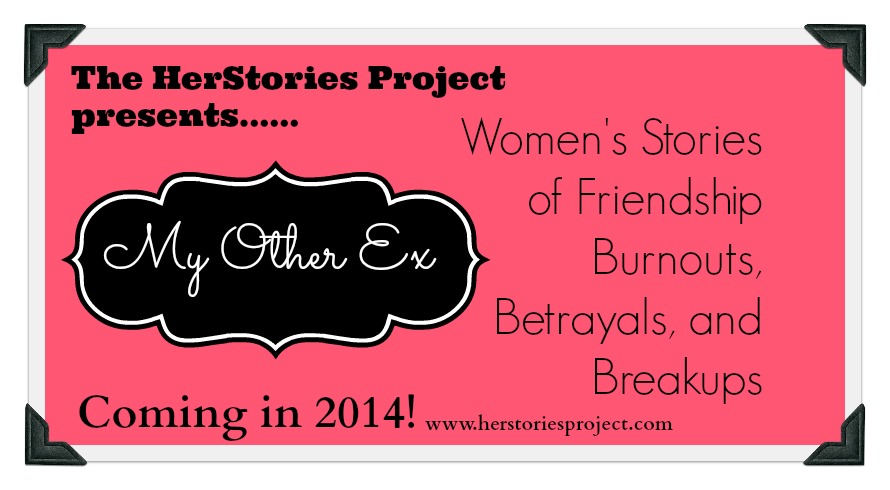
    myotherexjan2014After we announced our call for submissions for our next book, My Other Ex, we started hearing feedback almost instantly. Women wrote us, “I have a breakup story I’d love to tell, but I’m not sure I’m brave enough,” or “I haven’t thought about this woman in years, and I can’t believe how many emotions are coming up.” Some of our past contributors have told us that they’ve begun writing a breakup essay, and it’s just so much harder than they expected. Here’s what we’ve heard from some of these writers:

    • Attempting to write a break up story feels sort of ugly and dirty. It’s like sorting through a mess that you aren’t sure who really made or how it got to that point where neither one really feels like cleaning it up, or it is too overwhelming to do so.
    • Writing about my big friend break up has been only slightly easier than having root canal without drugs. But just like it is with a root canal, dealing with the issue is the only way to heal.
    •  I was more certain than I have ever been that the friendship was well and truly over.
    • Writing this and attempting to capture and express the initial affection and then the pain and anger has made me feel like I’ve been dumped by my best friend all over again.
    • Just the thought of her reading about it and knowing she affected me makes me want to punch her.

    Honestly, we’ve been experiencing the same thing writing our own essays; in fact, I (Stephanie) have written three different versions about three different friendships in the process of finding the right story to tell. I’ve emailed old friends, asking if they can remember specific details that happened nearly 20 years ago. I’ve cringed as old memories have drifted to the surface, and the accompanying emotions that I thought I’d buried long ago. One weekend, I firmly believe I made myself physically ill as I spent hours absorbed in my laptop and the caverns of my adolescent brain, astonished to realize how many long-forgotten moments made their way back into my memory.

    To say the least, it is draining, uncomfortable, and yet somehow exhilarating to tell our old stories about friendship breakups. Why is it so painful?

    Is it because of those painful emotional flashbacks? Is it because we feel a sense of shame because female friendships are supposed to last? Is it because there are no emotional “scripts” for how to cope with friendship loss, unlike the loss of a romantic partner?

    For every woman there may be a different reason for why it’s so hard to talk about or write about the end of a friendship, or maybe a combination of many different ones.

    Is it worth it to dredge up these feelings? Again, we turn to our contributors’ thoughts:

    • It allowed me to say what I have not been able to say to an important person in my life who has not only done me wrong, but herself wrong. It has given me a voice that I could not find for over a year. I hope something positive comes from it as I see this as the first step in a longer journey about a breaking up and trying to re-engage.
    • I thought that writing about it would make it easier, clearer somehow. That it would push away the fog of uncertainty and the dull ache that had been hovering just below the surface for more then four years. But it didn’t, really. For me, writing about it was messy and confusing and it asked more questions then it answered. It made me mad and sad all over again, but, strangely, when I was finished, I was more certain than I have ever been that the friendship was well and truly over. I realized that I had been holding on to the mistaken belief that we would someday come back to each other and heal whatever it was that went wrong, but the writing made me understand that that was never going to happen. And for that, if nothing else, I felt relief.

    Both of us — Stephanie and Jessica — felt that sense of relief after writing our own stories.

    We hope that this collection will allow women to realize that they are not alone in their feelings of confusion, heartbreak, guilt, and sadness. Most of all, through sharing our stories, we want to acknowledge the complexity of friendship.

    We would love to hear your story. If telling the story is much more difficult than you expected, know that you are not alone. We encourage you to keep trying to write your story. We want this collection to help women realize that they are not alone in their intense and sometimes confusing feelings. It’s not a topic that is frequently talked about, and we’d like to change that.

    Please submit your story here: https://herstoriesproject.submittable.com/submit

    We’ll be accepting submissions through early March. We’d also be grateful if you took our short, anonymous survey to help us understand more women’s experiences.


    Enhanced by Zemanta

    Keep reading

  • A Guest Post and a Free E-Book in Celebration of Friendship

    Stephanie and I have two things to share today that we’re excited about…

    First, in honor of both Valentine’s Day and International Book Giving Day, we’re offering our HerStories Project book for free as an e-book on Amazon for one day, today, Wednesday, February 10. Why not get a free e-book for yourself and buy one for your best friend, your sister, your mom, as a Valentine’s Day surprise? 

    vday

    We’re also proud to share a lovely story that our contributor Rose Townsend of the blog Naturally Educated shared with us about how her participation in the HerStories Project and our community of friends and writers led to an important realization about family and friendship:

    Sometimes I worry about my daughter.  At four, she is already rocking life.  She is creative, funny, determined and has more confidence than I can sometimes muster as an adult.  But there is one thing she doesn’t have.  It is something I have always had.  It is something I could not live without.  My girls.

    My twin cousins, my first two friends, were born six months before I arrived in this world.  One year later, my sister was born, followed by more cousins and eight years later, another sister.   I was set.  All of these lovely ladies lived either in my house or less than a few blocks away.  They were my greatest supporters, my confidants, my shoulders to cry on, my laugh until it hurts kind of friends for as long as I can remember.  They still are.  I even followed my twin cousins to college.  And one sister followed soon after.

    With two brothers and no female cousins nearby, I wonder what my daughter is going to do without these girls.  I wonder, who will stay up all night with her at her first sleepover? Who will be her fellow performers in elaborate song and dance routines?  Who will be driving as she sits in the passenger seat and sings her teenage heart  out?  Who will she call sobbing when she breaks up with her first boyfriend?  Who will sit in the stall next to her in a college dorm as the effects of her first night of drinking are emptied from her stomach.

    Who will tell her she looks great?  Who will tell her not to wear that outfit again?

    Who will she call when the stress of life, motherhood or marriage become too much to bear alone?  Who will tell her she is doing fine?  Who will call her out on her shit?

    Who will encourage her to take risks, to learn new things, to push herself?

    I worry.  Deep female friendships were my fate. What is my daughter’s?

    Some of these worries were eased as I read the essays in the HerStories Project anthology.  These stories of friendship gave me hope.  I learned that sisters are everywhere.  They are in childhood neighborhoods, grade schools, colleges, workplaces, mom’s groups and parks.  They are on the other end of the phone.  They are on the computer screen.  They are everywhere women are.

    Because where there are women, there is empathy and support.  There is safety and acceptance.  There is a place to confess your darkness and a place to share your light.  There is a place for tears of sadness and tears of joy, neither of which are questioned, but instinctively understood.  There is honesty and inspiration.  There is comfort.  The kind of comfort one can only find with sisters.  Not everyone is born with them, but the HerStories Project has made me believe that every woman will find her sisters.

    I already love those beautiful souls who will be my daughter’s future sisters.  I know they are out there, waiting to be her safe place.  They don’t know it yet, but they are going to have the coolest sister around.

    Enhanced by Zemanta

    Keep reading

  • Book Club With The HerStories Project

    Earlier this week, our contributor Nina Badzin shared her experiences with finding the perfect book club. As her post states, friendships and book clubs don’t always mix. Just because you enjoy the company of certain friends, neighbors, and co-workers doesn’t mean you’d necessarily click as a book club. The dynamics of a perfect book club have always reminded me of finding the right partner: sure, you may enjoy the same movies or share important values, but do you want the same things out of your relationship?

    The first book club I ever joined at the ripe old age of 22  made me feel terribly grown-up- I mean, I was in a book club! Wasn’t that what real adults did? Getting together with other intelligent adults to passionately and astutely dissect literature sounded right up my alley. After I forced myself to endure the torture of Kafka’s The Trial, I decided to spice things up with a new, out-of-the-box (heh heh) book about feminism. I chose a somewhat controversially titled book by Inga Muscio. To my great surprise and outrage, both the men and the women in the group tore my selection to shreds. The verbal evisceration continued outside the monthly meeting, extending into strongly-worded email exchanges. That was it. I was out.

    My most recent book club fell into the all-too-common trap that Nina alluded to: a bunch of women sitting around talking about their jobs and families and spending perhaps three total minutes talking about the book. Half of the group never read the book, and we too did that awkward dance where we tried to discuss the ending without ruining it for the slackers. “You know… when Martha has her transformation?” we would ask pointedly, raising our eyebrows at fellow book-finishers. “Ohhh, right. I agree- that part was very…pivotal.” Not much of a discussion.

    Even when I’m reading a book by myself, I frequently read through the Discussion Questions at the end. For one, if the book was engaging, I’m often in withdrawal already and am anxious to soak up just a few more pages before saying goodbye and moving on my next selection, which I’m already convinced could never measure up to its predecessor. I also enjoy taking a few minutes to process some of the nuances of the characters or plot, and maybe even apply the storyline to my own life.

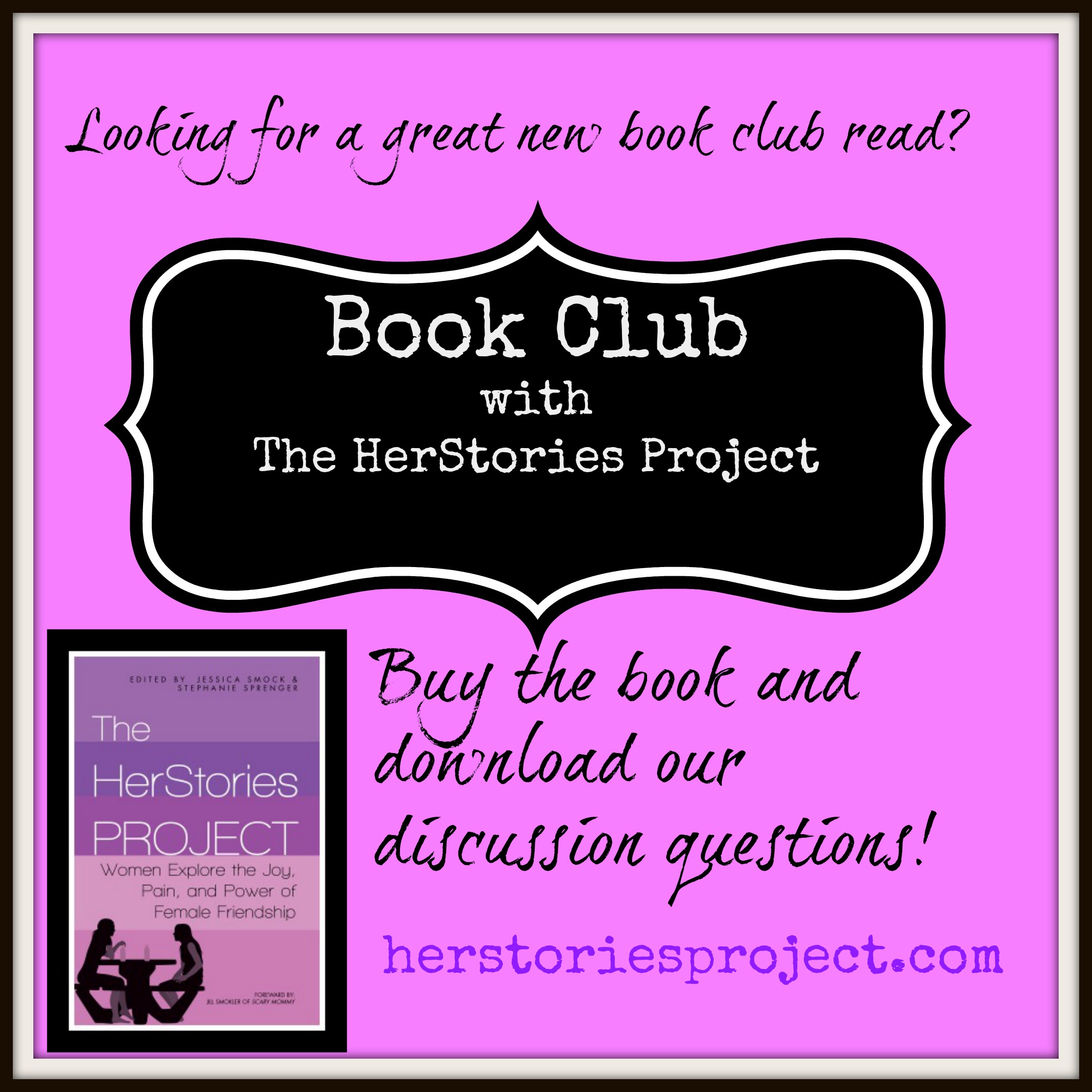
    Not surprisingly, we think The HerStories Project: Women Explore the Joy, Pain, and Power of Female Friendship would make the perfect book club book! We love how the book has inspired women to reflect on their own life experiences and friendships, and what better environment to dig deeper into the power of friendship than a (harmonious, dysfunction-free) book club?

    So to help you avoid falling into the traps I mentioned:
    a) The unfocused rant conversation
    b) The vague, unpleasantly brief, lacks direction discussion

    We’ve come up with some book club discussion questions that we invite you to use when discussing The HerStories Project with your book club! We will give them a permanent home in the menu of our website, but here they are!

    1. Which stories resonated with you the most? Why? Did they remind you of yourself, or of a particular friendship or time in your life?

    2. How long have you known your closest friends? Do you have any of the same friends you’ve had since childhood, high school, or college? When did you meet your current friends?

    3. When you think of your current friendships, how did you meet? Why did you decide to become close friends?

    4. Which qualities are most important to you in a friend? What important qualities do you bring to your friendships?

    5. If you are a mother, did you make any new friendships during your transition to motherhood? What did these relationships do for you? If you are not a mother, were there important transitions in your life– graduation, move to a new city, a new job, marriage– that brought new friends into your life? Why do you think we tend to form new friendships during these stages of extreme change and flux?

    6. Have you ever had a friendship breakup? Did you initiate it, or did your friend “break up” with you? How did you feel about it? Were you sad or relieved? Do you still miss your friend?

    7. Are there friends who are no longer in your life that you wish you could reconnect with? What would happen if you did, and what reasons would compel you to try again or keep your distance?

    8. Have you ever mourned the loss of a friend? What helped get you through it?

    9. How are your friendships similar to romantic relationships? How are they different? Are you more or less emotionally intimate with your girlfriends than you are with your partner?

    10. How often do you need to spend time with your friends to feel happy and balanced? What obstacles do you face that prevent you from staying in touch with your friends? How can you stay more connected and still make time for yourself, your family, and your job?

    BookClub2If you haven’t bought your copy of the book yet, you can order one right here, and send your fellow book club members over, too! In the spirit of friendship, consider buying The HerStories Project for a friend for February 14th: International Book Giving Day. We think it is a great tribute to the importance of female friendship in a woman’s life.

    Happy Reading!

    Enhanced by Zemanta

    Keep reading

  • When Friendships and Book Clubs Do Not Mix

    FULL RES - Badzin-03 copy-1This week we’re thrilled to publish a guest post by HerStories Project contributor Nina Badzin. Lots of women are enthusiastic members of their book clubs, but it’s also true that not every woman is looking for the same thing when she joins one. Have you ever been a “mismatch” with a book club that you’ve joined? Read Nina’s experience with trying to combine friendship and book clubs:

    bookclubcurse

    I always wanted to be part of a book club.

    My initial desire started young when I observed my mom’s enthusiastic participation in one. However, I didn’t realize as a kid that my mom and her fellow book club members were brought together through a shared love of reading and nothing more. They were certainly very friendly on account of the book club, but they didn’t create the book club because they were close friends. The difference is significant, which took several failed book clubs for me to understand.

    I started my first book club in the summer of 2000. I was twenty-three and had recently moved to Minneapolis where I knew my husband’s (then fiance’s) family and not another soul. In my fantasy of young almost-married life, I had to be part of a book club. Aside from the model of my mom’s club, I also had Oprah. The summer of 2000 was the heyday of Oprah’s book club. People were reading the same books all over the country, discussing them in cozy groups while sipping wine in well-designed living rooms. I wanted in! More than anything though, I wanted to make friends.

    I created a book club as soon as I’d made two friends, and they invited others they knew. I remember not liking some of the novels we chose, but like my mother, I always finished so I could participate. My frustration when others didn’t finish or when we didn’t really discuss the book was palpable. Let’s just say I wasn’t the most popular woman in the group and instead of making new friends, I made people mad. Eventually I quit, which made me look like a snob (according to the unsolicited feedback that came back to me later). The experience was a disaster both from a book lover’s point of view, and as someone trying to make new friends in a new city.

    I tried another group with some different friends the next year, but the same thing happened. We’d rarely discuss the book because not everyone had read it. Now before you think I’m completely anti-social, let me say that I do love hearing about everyone’s lives, catching up, and simply hanging out. But I longed for a book club where the women wanted to talk about the books. I mean really discuss them–like speaking over each other and having to eventually cut off the conversation when it gets too late kind of discussing. I was also a ninth grade English teacher then, which meant I already spent time forcing a discussion about a book as a job. I didn’t want to do that in my free time too!

    Fast forward a few years. A friend of mine invited me into a book club with some women she’d known in high school. This book club didn’t work out for me either because those of us who read the book weren’t supposed to “ruin” the ending for the others. When I accidentally broke that rule, the group’s unofficial leader sent a scathing email to the entire group reminding us how “unfair” it was to spoil the ending. Any book lover will understand why I left that group immediately. I also realized that I didn’t want to be in a book club with a group of old friends–my friends or anyone’s.

    Since then I’d been invited into other groups, but I’d always decline. In a smaller community like Minneapolis, I didn’t think I could afford to make any more bad impressions with people based on my desires to discuss the dang book.

    However, two neighbors I was friendly with insisted many times that I try the neighborhood club. They promised that everyone in the group was an enthusiastic participator. And they were right! I’ve been in that group for two years now, and I finally found the club where I belong. The women range in age from 35 to 65, which helps keep conversation from lingering too long on subjects like potty training or even college visits. We are all at different points in our lives and come from a variety of backgrounds, but what we all have in common in any particular month is the book we read. Our differences bring layers to the discussion and bring up issues from the book that hadn’t occurred to me on my own.

    As for friendship, of course after two years we’ve developed a friendliness above and beyond “fellow book club member.” I was incredibly touched when some of the women from the group carpooled to see me in the Listen to Your Mother show last year. And when an interesting author comes to town we have tried to make an outing of that, too. We’ve arranged for author visits as well either in person or via Skype. I must say it’s the perfect book club (for me) made even more wonderful by each host living no more than five minutes from my house. Luckily this book club saga had a happy ending!

    Have you been able to create a successful book club with close friends or has your experience been more like mine?

    Keep reading