friendship

  • The Case for Mixing Business and Friendship

    elura

    I’m happy to introduce a guest post by one of my oldest and dearest college friends, Elura, who was also a contributor for The HerStories Project book published in December. From the day that I met her freshman year I’ve continued to be impressed by Elura’s “take charge” attitude, loyalty, and sense of humor. She is one funny woman. She’s a true friend — someone that you know will always have your back. And, of course, she’s my only friend that has her own reality show on OWN, Oprah’s network, and the only one that I’m likely to see arguing with other guests on cable television when I’m at the gym. Here’s Elura’s take on a subject dear to both Stephanie’s and my hearts: friends as business partners. -Jessica


    People love to give unsolicited advice, particularly when the subject of that advice is something about which they know almost nothing. I’ve had literally hundreds of people tell me that they’d “never go into business with a friend” — when the truth is that most of those folks would never go into business, period. But there seems to be an almost unspoken wisdom about the idea that one should never mix girlfriendship with one’s career. I’m here to tell you that that “wisdom” is not only a load of crap, but is also evidence of the remaining gender gap in the workplace.

    First, I’d like to explore the utter lack of truth of the assumption that friendship is some kind of handicap for entrepreneurship. Starting a business — whether that business is a law firm, a medical practice, a bookstore, a cupcake truck or a lemonade stand — is an exciting, frightening, risky, and potentially rewarding undertaking. It will be draining, emotional, and confusing at times. Hopefully, it will also be a rewarding source of emotional and financial pride. So why on earth would we avoid sharing those things with someone who has already been vetted for compatibility and loyalty? Yes, I’ve heard the logic that when the business fails, it’ll affect the friendship. Or that when the friendship fails, it’ll affect the business.

    But are we really going through life with this kind of uberdefeatist attitude? What about The Secret and the law of attraction and all that Oprahworthy mindset stuff? Let me tell it to you straight: if you are starting a business already planning for its failure, then your business is going to fail, and it’s not because you picked the wrong partner. The same goes for a friendship. I certainly don’t suggest that you pick a friend at random with whom to begin a venture. But if you have a friend with whom you work well, share values, and enjoy creating plans, don’t reject the one person who might make a fabulous co-CEO, just because you heard an idiom that seemed to prohibit working with a friend.

    And while we’re on the subject, let’s take a minute to recognize that no one would ever tell a man not to go into business with a “contact” he has because the two of them like to go fishing together. When talking about business, men tend to call their friends “associates” or “contacts” — but let’s not allow their imprecise use of language obscure the truth. When men spend enjoyable time together talking, drinking, hunting, golfing, etc. — they are “friends.” When those same men collaborate in a business venture, they have, in fact, “gone into business with a friend.”

    So I invite all of you to join me in taking pride in trusting my own friendships enough to share a bank account with the same person with whom I can share shoes. After all, isn’t the ultimate success that which you share with someone you love?

     

    Elura-and-MicheleElura Nanos, Esq, has owned a business with her best friend, Michele Sileo, Esq., for over a decade.  Together, the two have founded an award-winning business, co-authored three books, and landed their own reality series Staten Island Law.  Elura and Michele regularly give keynote speeches and do television appearances together.
    Follow them both on Twitter: @elurananos @michelesileo1
    Enhanced by Zemanta

    Keep reading

  • Why It’s So Hard to Write About Friendship Breakups

    myotherexjan2014After we announced our call for submissions for our next book, My Other Ex, we started hearing feedback almost instantly. Women wrote us, “I have a breakup story I’d love to tell, but I’m not sure I’m brave enough,” or “I haven’t thought about this woman in years, and I can’t believe how many emotions are coming up.” Some of our past contributors have told us that they’ve begun writing a breakup essay, and it’s just so much harder than they expected. Here’s what we’ve heard from some of these writers:

    • Attempting to write a break up story feels sort of ugly and dirty. It’s like sorting through a mess that you aren’t sure who really made or how it got to that point where neither one really feels like cleaning it up, or it is too overwhelming to do so.
    • Writing about my big friend break up has been only slightly easier than having root canal without drugs. But just like it is with a root canal, dealing with the issue is the only way to heal.
    •  I was more certain than I have ever been that the friendship was well and truly over.
    • Writing this and attempting to capture and express the initial affection and then the pain and anger has made me feel like I’ve been dumped by my best friend all over again.
    • Just the thought of her reading about it and knowing she affected me makes me want to punch her.

    Honestly, we’ve been experiencing the same thing writing our own essays; in fact, I (Stephanie) have written three different versions about three different friendships in the process of finding the right story to tell. I’ve emailed old friends, asking if they can remember specific details that happened nearly 20 years ago. I’ve cringed as old memories have drifted to the surface, and the accompanying emotions that I thought I’d buried long ago. One weekend, I firmly believe I made myself physically ill as I spent hours absorbed in my laptop and the caverns of my adolescent brain, astonished to realize how many long-forgotten moments made their way back into my memory.

    To say the least, it is draining, uncomfortable, and yet somehow exhilarating to tell our old stories about friendship breakups. Why is it so painful?

    Is it because of those painful emotional flashbacks? Is it because we feel a sense of shame because female friendships are supposed to last? Is it because there are no emotional “scripts” for how to cope with friendship loss, unlike the loss of a romantic partner?

    For every woman there may be a different reason for why it’s so hard to talk about or write about the end of a friendship, or maybe a combination of many different ones.

    Is it worth it to dredge up these feelings? Again, we turn to our contributors’ thoughts:

    • It allowed me to say what I have not been able to say to an important person in my life who has not only done me wrong, but herself wrong. It has given me a voice that I could not find for over a year. I hope something positive comes from it as I see this as the first step in a longer journey about a breaking up and trying to re-engage.
    • I thought that writing about it would make it easier, clearer somehow. That it would push away the fog of uncertainty and the dull ache that had been hovering just below the surface for more then four years. But it didn’t, really. For me, writing about it was messy and confusing and it asked more questions then it answered. It made me mad and sad all over again, but, strangely, when I was finished, I was more certain than I have ever been that the friendship was well and truly over. I realized that I had been holding on to the mistaken belief that we would someday come back to each other and heal whatever it was that went wrong, but the writing made me understand that that was never going to happen. And for that, if nothing else, I felt relief.

    Both of us — Stephanie and Jessica — felt that sense of relief after writing our own stories.

    We hope that this collection will allow women to realize that they are not alone in their feelings of confusion, heartbreak, guilt, and sadness. Most of all, through sharing our stories, we want to acknowledge the complexity of friendship.

    We would love to hear your story. If telling the story is much more difficult than you expected, know that you are not alone. We encourage you to keep trying to write your story. We want this collection to help women realize that they are not alone in their intense and sometimes confusing feelings. It’s not a topic that is frequently talked about, and we’d like to change that.

    Please submit your story here: https://herstoriesproject.submittable.com/submit

    We’ll be accepting submissions through early March. We’d also be grateful if you took our short, anonymous survey to help us understand more women’s experiences.


    Enhanced by Zemanta

    Keep reading

  • A Guest Post and a Free E-Book in Celebration of Friendship

    Stephanie and I have two things to share today that we’re excited about…

    First, in honor of both Valentine’s Day and International Book Giving Day, we’re offering our HerStories Project book for free as an e-book on Amazon for one day, today, Wednesday, February 10. Why not get a free e-book for yourself and buy one for your best friend, your sister, your mom, as a Valentine’s Day surprise? 

    vday

    We’re also proud to share a lovely story that our contributor Rose Townsend of the blog Naturally Educated shared with us about how her participation in the HerStories Project and our community of friends and writers led to an important realization about family and friendship:

    Sometimes I worry about my daughter.  At four, she is already rocking life.  She is creative, funny, determined and has more confidence than I can sometimes muster as an adult.  But there is one thing she doesn’t have.  It is something I have always had.  It is something I could not live without.  My girls.

    My twin cousins, my first two friends, were born six months before I arrived in this world.  One year later, my sister was born, followed by more cousins and eight years later, another sister.   I was set.  All of these lovely ladies lived either in my house or less than a few blocks away.  They were my greatest supporters, my confidants, my shoulders to cry on, my laugh until it hurts kind of friends for as long as I can remember.  They still are.  I even followed my twin cousins to college.  And one sister followed soon after.

    With two brothers and no female cousins nearby, I wonder what my daughter is going to do without these girls.  I wonder, who will stay up all night with her at her first sleepover? Who will be her fellow performers in elaborate song and dance routines?  Who will be driving as she sits in the passenger seat and sings her teenage heart  out?  Who will she call sobbing when she breaks up with her first boyfriend?  Who will sit in the stall next to her in a college dorm as the effects of her first night of drinking are emptied from her stomach.

    Who will tell her she looks great?  Who will tell her not to wear that outfit again?

    Who will she call when the stress of life, motherhood or marriage become too much to bear alone?  Who will tell her she is doing fine?  Who will call her out on her shit?

    Who will encourage her to take risks, to learn new things, to push herself?

    I worry.  Deep female friendships were my fate. What is my daughter’s?

    Some of these worries were eased as I read the essays in the HerStories Project anthology.  These stories of friendship gave me hope.  I learned that sisters are everywhere.  They are in childhood neighborhoods, grade schools, colleges, workplaces, mom’s groups and parks.  They are on the other end of the phone.  They are on the computer screen.  They are everywhere women are.

    Because where there are women, there is empathy and support.  There is safety and acceptance.  There is a place to confess your darkness and a place to share your light.  There is a place for tears of sadness and tears of joy, neither of which are questioned, but instinctively understood.  There is honesty and inspiration.  There is comfort.  The kind of comfort one can only find with sisters.  Not everyone is born with them, but the HerStories Project has made me believe that every woman will find her sisters.

    I already love those beautiful souls who will be my daughter’s future sisters.  I know they are out there, waiting to be her safe place.  They don’t know it yet, but they are going to have the coolest sister around.

    Enhanced by Zemanta

    Keep reading

  • The HerStories Project: More Than Just a Book About Friendship

    We’re honored to introduce a guest post one of our HerStories contributors, Julie Burton of Unscripted Mom!

    Julie and her lifelong friend, Dina and Laura
    Julie and her lifelong friends, Dina and Laura

    The Community Established

    It has been over a month since the release of Jessica Smock and Stephanie Sprenger’s book The Her Stories Project. The most striking aspect of being a part of this project is how Jessica and Stephanie not only skillfully compiled and published the book but that they worked/and continue working to create a strong, supportive community amongst the 50 contributors. It truly has been an honor to be a part of this amazing community of women writers. Although I have been a writer for most of my adult life, I was a bit late to the mommy blogging party that began several years ago, and really took off when blogs like Scary Mommy went viral.  My blog will celebrate its first birthday in March.

    I always found my writing career to be somewhat lonely. Until recently, I didn’t have any writer friends to speak of. Also, I am a gen-X-er and not a gen-Y-er, so I also didn’t fully “get” how to use social media to connect with like-minded writers. But then, last year, local writer and fellow contributor Nina Badzin appeared in my life (which is a friendship story in its own right), and she taught me “blogging and tweeting 101” (she really should offer an on-line course). She also introduced me to Jessica, Stephanie, and many other great writers and witty, engaging and inspiring mom bloggers. I am extremely grateful for the strength and connectedness I have found in this community, and how Jessica and Stephanie made sure that as they wove the essays together in their book, they also linked together the women behind the words.

    Essential Lessons Learned

    3typesfriendship

    As I mother my four children and help guide them through the ups and downs of their friendships, I am continually reminded of how important friendships are, and how even at my age, some friendships can still be tricky to navigate. The essays in The Her Stories Project explore the beauty and the pain of friendship, as well as all the gray areas in between.

    It has made me take a closer look at my friendships, both past and present—the ones that lasted a lifetime, the ones that fizzled out over time and the few that ended abruptly leaving a bad taste in both of our mouths, and an unsettledness in our hearts.

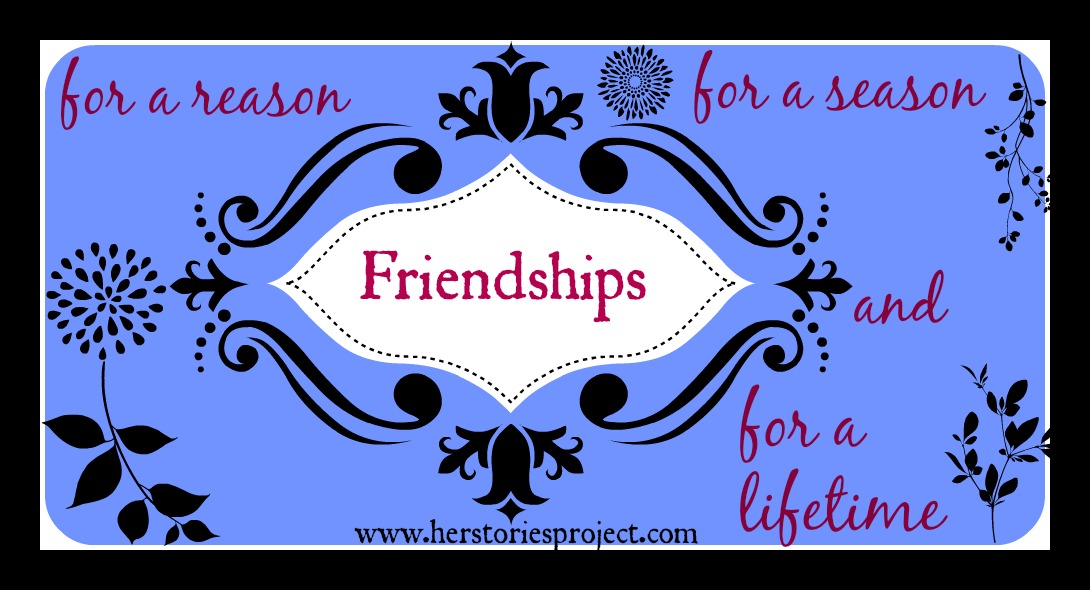
    Reason. Season. Lifetime,” my friend simply stated when I began talking to him about friendships.

    “What do you mean?” I asked. He explained that there are three different kinds of friends:

    • Reason—these are friends you bond with for a reason—you work out with them, you attend a study group with them, you serve on a committee with them. They serve a purpose and a fulfill a current need for companionship in your life.
    • Season—these friendships often happen as a result of something that brings you together and keeps you together for, on average, five to seven years—your kids go to school together, you are in the same book club, you are neighbors or you work together. Oftentimes, these friendships fizzle out when the season that brought you together ends—your kids attend different high schools, you change jobs or move.
    • Lifetime–The third kind of friendship, which you are truly lucky if you have even one, is, of course, the lifetime friend. Your relationship has stood the test of time. She knew you when, she knows you now and she still loves you, and you feel the same way about her. These friendships are the most sturdy and reliable friendships. (I truly don’t know where I would be without my lifetime friends.)

    Women need all three of these types of friendships, and they are each meaningful and fulfilling in different ways. And certainly a “reason” or “season” friendship can evolve into a long-standing friendship. When I step back to look at women and friendships in general, I notice that many women shy away from talking about friendships that are more challenging (which is why Jessica and Stephanie’s book is so important).

    Women often think their friendships should be easy and natural, but when they are not, many women feel a certain amount of shame and they just want to move on. Dr. Irene S. Levine takes a close look at women’s friendships in her 2010 article in the Huffington Post:

    “Despite the romanticized myth of BFF, the hard truth is that most friendships don’t last forever. In fact, research suggests that when it comes to friendships, a phenomenon occurs that is somewhat akin to the seven-year itch: Half of our close friendships turn over every seven years. Women are reluctant to talk about their friendship problems, which turn out to be quite common: losing friends, having unfulfilling friendships, or having no friends at all. Just like other life-affirming relationships that we treasure–relationships with lovers, husbands, siblings, children, and pets–our closest friendships tend to be imperfect. Friendships are fraught with disappointments and misunderstandings—resulting in some of the highest highs and the lowest lows of our emotional lives.”

    For me, I know that I have been an amazing friend and I have been a shitty friend (not intentionally). I have been a devoted friend and a “checked-out” friend. I have hurt friends and been hurt by friends. But from each friendship, I have learned and grown, and I hope my friends feel the same way.

    For mothers, our friendships are essential. They don’t have to be the Cosmo drinking, lunching or hitting the town several nights a week, Carrie Bradshaw and her girl gang types of friendships. However, an integral part of being a healthy woman and mother (which I cover in complete detail in my upcoming book on motherhood and self-care) is to be mindful and thoughtful about friendships. Mothers are exploring the unknown, sometimes terrifying territory of raising kids, while often managing a career and relationship with their partner (or ex-partner). When moms need assurance, acceptance, clarity, validation, support, guidance, love and trust, we often turn to our friends before anyone else (including our partners).

    So, in the spirit of friendship, give this a try (or even a thought): On a regular basis, make a point to reach out to a new friend, an old friend, or maybe even an estranged friend, and say or do something that could literally make her day. It could be as simple as a phone call to say, “Hi, I am thinking about you.” Without having any expectations, notice what transpires, within yourself and within your friendships.

    Have you had a friendship that ended, either gradually or suddenly? Either by your choice or your friend’s? Please take our friendship breakup survey… You could win a $25 gift certificate to Amazon!

    Enhanced by Zemanta

    Keep reading

  • A New Year, A New Project: Our Call For Submissions

    myotherexjan2014Have you ever lost a friend? Was that loss in some ways more painful than the end of a love affair?

    In our first collection of stories of friendship by female writers, The HerStories Project: Women Explore the Joy, Pain, and Power, we included a section on friendship loss. The response to that part of the book has fascinated us. Stephanie and I found that we couldn’t stop thinking about this aspect of friendship: Why is it so painful for a friendship to end and why is it so hard for women to talk about?

    Again and again, other women — friends, readers, relatives, acquaintances —  have told us stories of their own friendship breakups and dissolutions.  In their stories, we’ve heard their pain, their shame, their confusion, and their continued sense of deep loss.

    Now we’re wondering if you can help us out with our next project: We want to hear your stories of friendships from any time in your life that have ended — from friends who left you  or others that you left. The friendship that ended suddenly or the one that faded gradually.

    Blank Open Book - Illustration

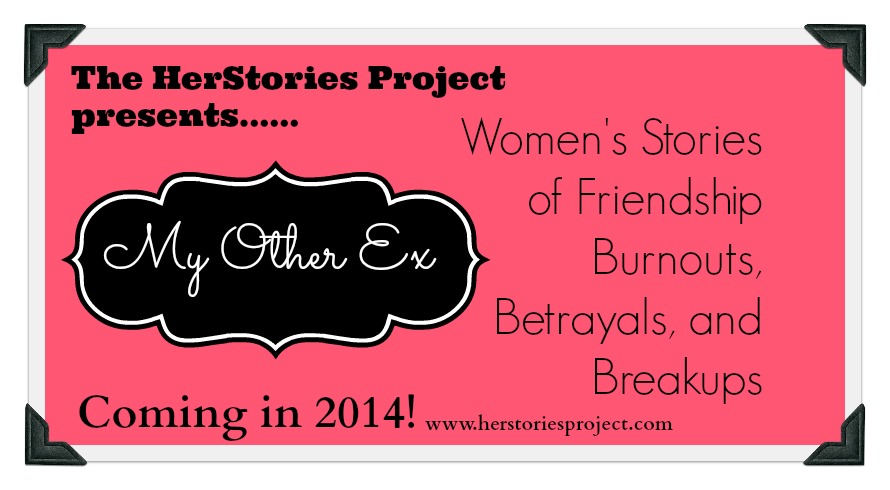
    We are happy to announce our call for submissions for our next anthology. This collection — tentatively titled, “My Other Ex: Women’s Stories of Friendship Burnouts, Betrayals, and Breakups”—  will include essays about a friendship that has ended. Maybe there was a reconciliation later in time, maybe there wasn’t. Maybe the ending of that bond brought enormous pain or maybe its conclusion brought great relief.

    You can also help us out by completing our survey or participating in the project in other ways, such as a private Facebook group or e-mail interviews.

    Click below to submit a story to us by February 24, 2014 about a friendship that ended. Submissions should be previously unpublished and between 1000 and 4000 words. (If you have a previously published piece that you would like to rework, feel free to ask us about it too.) Please include a brief biography and your contact information (e-mail, blog address, social media links). E-mail us at info@herstoriesproject.com with any questions! We’re so excited to start this project with all of you!


    Submit to The HerStories Project


    Enhanced by Zemanta

    Keep reading

  • A New Year’s Update: New Friends and New Beginnings

    2013 was quite a year for Stephanie and me: we both had new blogs of our own, we met, we started the HerStories blog, we compiled a book of essays, we published it, and we continue to be thrilled by the extraordinary relationships and connections that we’ve made through this project.

    During the past few weeks, we’ve been honored to receive kind words about our project from several of our writing “idols.” For instance, Kate Hopper, the memoirist and writing instructor whose book Use Your Words: A Writing Guide for Mothers has become a trusted guide for many mom writers (including us!), read our book and left us with a beautiful review. Rachel Macy Stafford, who writes the extraordinary blog Hands Free Mama, took time from getting ready for the release of her new book, Hands Free Mama: A Guide to Putting Down the Phone, Burning the To-Do List, and Letting Go of Perfection to Grasp What Really Matters!, to tell us how she moved she was by our contributors’ stories.

    And today Jill Smokler of Scary Mommy is featuring our guest post on her blog. We wrote a guest post about making online friendships. We were so honored that Jill agreed to write the foreword to the book, and she continues to be an amazing supporter of this project.

    In some ways, it’s not surprising that a book about the power of female friendship has led to…. more female friendships and new bonds between new and experienced writers.

    But for Stephanie and me, this has been one of the most gratifying parts of this project: seeing new relationships develop among our contributors as well as making new connections of our own within several writing communities.

    We can’t wait to see what 2014 has in store for The HerStories Project! (Hint: This month we’ll be announcing the topic and details of our next project…. Stay tuned for details!!)

    Are friendships and relationships a part of your goals and hopes for the New Year? We’d love to hear about them!


    Enhanced by Zemanta

    Keep reading