Month: June 2013

  • Yoga Bonding

    We’re delighted to be sharing Sarah’s story of friendship during her first years of motherhood.  Sarah has a fantastic blog, Left Brain Buddha, where she writes about parenting and mindfulness.

    It’s early evening, and I’m six months pregnant with my first child, walking my dog after prenatal yoga class. Not one minute into my walk, a pregnant woman comes running out of her house waving at me. “Hey! We’re in the same yoga class!”

    We had been neighbors for months, and had never met. Yet our due dates were only two days apart. We were both pregnant with girls. We both loved yoga. We would be giving birth at the same hospital. I love synchronicity!

    We got together a few times before our children were born, but we really came to know each other once we entered first-time motherhood together. Our girls ended up being born five days apart.

    When my daughter was three months old, I took her to our first Yoga Bonding class ~ and there was my new friend, too! I loved these Wednesday yoga classes. We joked about how that one-hour yoga class managed to fill up the whole day — figuring out how to get Mom and baby dressed, fed, and inevitably re-dressed to make it to class by 11:15, scheduling naps around class, then bundling the babies back up in their carseats to get them home in a frigid January, followed by napping and recovering from yoga. That’s an exhausting day for a new mama!

    And I craved that kind of structure and time with a friend during my days as a new mom. I had a rough time in those first months of motherhood. My daughter woke almost hourly during the night, napped for only 30 minutes at a time, and spent many of her waking hours crying — and so did I. I didn’t realize it at the time, but what I took for “baby blues” had progressed into postpartum depression. Despite going to yoga bonding, I didn’t feel I was bonding with my daughter. Motherhood felt like a job I approached intellectually, rather than a passion I pursued out of love. My friends spent their days at work. I felt isolated and thought I was a terrible mother.

    And then at one of our Yoga Bonding classes, my friend asked me if my husband and I would babysit her daughter for a few hours one evening. I felt so honored and flattered and relieved by the request. I was touched that she trusted me to watch her little girl, and it reassured an insecure new mom that at least someone thought I was doing things right. She’s trusting me with her child!

    The night my husband and I babysat, I came to two important realizations: first, It is way harder to have two infants at once, and second, I really had bonded with my daughter. While I loved cradling my friend’s sweet child in my arms, my heart ached. I wanted to be holding my baby! Even though I’d spent the entire day carrying her as she fussed, I longed to hug and kiss her again and sing her to sleep.
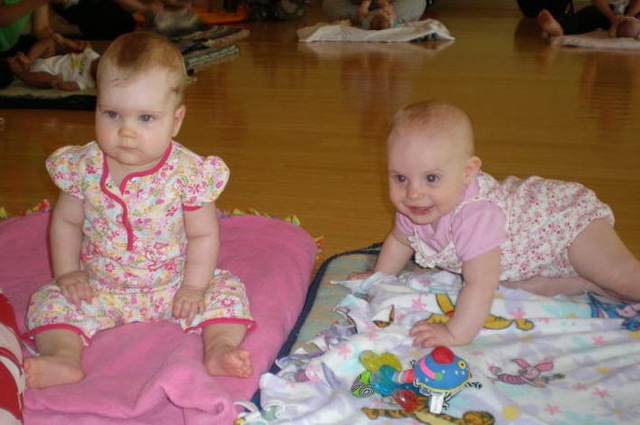
    Yoga002-001

    Caring for another baby made me realize how in tune I was with my own daughter ~ my friend’s little one took her bottle differently, cried differently, needed to be soothed differently, and, holy cow, could that child spit up!

    Our families began to spend a lot time together: dinner gatherings (which usually began around 4:45 pm to accommodate baby bedtimes), long daytime walks around the neighborhood and the lakes, and lots of playdates (if they can be called that when the kids can’t even walk.) But at that age (and maybe all ages), the playdates are more for the moms, right? I treasured the laughter, the conversation, the advice, and the confessions that my friend and I shared.

    Our girls grew up together, played together, and spent every Sunday morning together while their dads walked them in their strollers to go to the local coffee shop for donuts. Then the six of us would spend a leisurely morning on our patio, enjoying coffee, sweets, and company while the girls played.
    We moved on to Yoga for Crawlers. First birthday parties. Trick-or-Treating. Second children.

    And just when I got pregnant with my second child, they moved away! It was hard to see my mama-friend, and my daughter’s best bud, leave. Even the baristas at the coffee shop expressed their sadness that our little girls wouldn’t continue to grow up together.

    We keep in touch now through Facebook and social media. When our children get together for visits, even though the girls are now almost seven, and they were separated when they were two, it’s like they’ve been girlfriends for a long time.

    I know the feeling. Here’s to yoga bonding.

    IMG_8771

    Sarah Rudell Beach, is a teacher, wife, and a mother to two energetic little ones. At Left Brain Buddha she explores ideas and practices for mindfulness, and shares the challenges and riches in her journey to live and parent mindfully in a left-brain, analytical life. She encourages you to discover the amazing transformations that can occur when we not only indulge, but learn to tame, our monkey minds.

    Enhanced by Zemanta

    Keep reading

  • Being Alone and Being Lonely Are Two Different Things

    Here’s one thing I’ve learned in my two years as a mother: experiencing solitude and experiencing loneliness are not the same thing.

    Before I became a mom, I frequently sought out solitude, but seldom felt lonely.

    Pre-baby hammock relaxation
    Pre-baby hammock relaxation

    Now I sometimes feel a bit lonely but — until recently — hardly ever experience true solitude in the same way that I did before having a child.

    I’ve been reading One and Only: The Freedom of Having an Only Child, and the Joy of Being One by Lauren Sandler, and Sandler makes some provocative and insightful points about what we think we “know” about only children.  (I’m reading it for my Parenting Book Book Club For Parents Who Hate Most Parenting Books over at School of Smock.  Join the ongoing conversation about this book and Parenting Without Borders: Surprising Lessons Parents Around the World Can Teach Us by Christine Gross-Loh!)

    According to Sander, being alone is an objective state.  You may like it; you might not.  You may find being alone recharges your energy (as introverts like me do), or you may prefer to be around others.  But loneliness is different.  You’re not happy when you’re lonely.  You’re missing a connection with others.  It’s unpleasant.

    In our culture, Sandler states, “We often mistake loneliness with solitude, confusing a state of grievous misery with a placid state of contentment.”

    One of the main themes of the book is that only kids are not necessarily lonely at all, despite the stereotype.  They learn to be their own companions and are generally content in their own company.  They are more likely to be self-sufficient, to have a strong sense of self.    That only kid sitting by himself in the sandbox or drawing pictures without siblings may not be lonely at all, although it’s tempting to feel sorry for him.  But he might not be longing for company in the slightest.

    On the other hand, motherhood can be truly lonely.  A new mom can literally never be all alone during the whole day:  surrounded by toddlers at the park, accompanied to the bathroom by her child, woken to the sounds of a screaming child over the baby monitor during the quiet first rays of morning sunlight.  But she may not feel a constant daily connection to friends or to a support system.

    Solitude is about finding the time and space to have a deep relationship with yourself.  Solitude can be “down time,” moments to reconnect and recharge.

    I experience solitude and peace during:

    • reading
    • walking or running
    • cooking a long meal

    For me, cultivating happiness as a mom is about finding that balance: connecting with myself and with others.  Connecting enough not to feel lonely, allowing myself to be alone enough to be calm.

    In One and Only, Sandler contends that only children are particularly good at this balance.  They’re skillful at forming and keeping social connections — on their own terms — but also seek and cherish time alone.

    How do you find this balance?  Do you think that only kids are better at this balancing act?

    Enhanced by Zemanta

    Keep reading

  • Big Girl Friendships

    Vicky

    We love today’s essay from Vicky Willenberg of The Pursuit of Normal. Vicky’s writing style is so unique and relatable, and  her thoughts on how friendships change through the years really resonated with us. How have your friendships evolved since childhood? Did you have a “grown-up” friend who helped you navigate new motherhood?

    I was 8 years old the first time I made the walk from the bus stop to my house in tears because I was being made fun of by my “best friend” and the crew that picked her side in our latest argument.  It was less than 2 weeks later when it was my turn to be on the “winning side” as she made the same walk of shame.

    I was 15 when my high school friend returned from studying abroad for the summer and didn’t call me as soon as she unpacked.  She didn’t call for over a week, as a matter of fact.

    I was 20 when my college friend hooked up with a guy I met earlier in the night and then proceeded to tell me she did it knowing I’d forgive her because that’s just how I am.

    I was 22 when a misunderstanding led to 15 years of no communication with someone who was one of my closest friends and had a starring role in my best memories of college.

    In between all these painful memories are years and years of laughter and fun times. I had wonderful friends and great experiences. But these friendships all felt so fragile- like they would break under the slightest weight of judgment or mistakes. I couldn’t help but wonder if it would always be like this.

    I was 23 when I met my first grown up best friend.  It changed the way I defined friendship forever. What’s the difference between little girl friendships and big girl friendships?  The difference is everything.  When I reflect on the little girl relationships of my past, they hang on hooks of laughter, sleepovers, silly arguments, crushes and broken hearts, and ever-changing cliques.  They are no less valuable than the friendships of a big girl and they served their purpose in defining who I am. However, we were children, so our friendships were founded on childish things and in turn, they lacked depth.

    At 23, the friendship I developed was built upon the things of grown ups: faith, marriage, relationships and career. I was no longer working through how to define myself nor experimenting with philosophies.  It was time to take who I was and turn it loose on the world. This was a scary time for me.  I was picking a career, not a job.  I was getting married, not deciding whether or not to give someone my phone number. The risks were bigger and the cost of failure was greater. This was the time in my life that I needed the best people on my side. Those who would cheer for me when I succeeded, encourage me when I was losing faith and catch me when I fell.

    Just a year or two ahead of me in most things, my grown up best friend had the wisdom of someone with experience and the understanding of someone who had only recently been through it.  She helped me through newlywed fights and decorating first homes, “we hired someone else” and “why doesn’t he just know what I need”. And we had loads of fun- yoga, Spin, kickboxing, pedicures, weekend BBQ’s and introducing the husbands. The two of us became the 4 of us which quickly became a lot of us as we shared friends and brought in new people. All grown ups with grown up lives and grown up friendships.

    I was 29 when I had my first child.  I was not the first of my grown up friends to have a baby, nor was I the last.  But it was MY first child and I was overwhelmed.  Nothing prepared me for all the parts of my life that would change.  I knew sleep would become a distant memory as would my waistline. I expected the strain on my marriage as roles and expectations were defined, redefined and then redefined again.  I was prepared to mourn the loss of my career while embracing the choice to stay home.  What I did not expect, what I was not prepared for, was feeling the heavy burden of responsibility that came along with becoming a mother.  For me, it was crushing.  Every decision, no matter how trivial, felt monumental and I felt like I had to “get it right.”  Whether it was sleep training or nursing, playgroups or discipline- it all felt so incredibly big, so incredibly impossible.

    However, I was not alone in this.  The burden wasn’t solely mine.  I had a wonderful husband who, although often confused about why I was so upset, encouraged and comforted me.  I had a mother who supported and educated me. But most important, I had a grown up best friend- my person. And my best friend knew me- truly knew me.  This was the friend with whom my fears and frustrations could be laid bare.  This was the friendship that kept my head above water with encouraging words and a frustrated “calm down” when necessary.  This friendship was the safe place within which I could release frustrated tears and whisper my greatest fears- I didn’t love being a mom and I think there might be something wrong with me.  This was the voice on the other end of the phone that told me I was normal, everyone felt like me, I wasn’t a bad mom and it was ok if I needed help. This friendship was authentic and reliable. It was my safe harbor in the storms of life.

    The little girl friendships of my youth were not built on unfiltered honesty, unwavering loyalty and fierce protection. In fact, many of those friendships never survived the challenges of the grown up world.  It was the big girl friendship developed in the grown up world of marriage and solidified through the universal battles of motherhood that was my strength when life felt too big and too much to handle.


    Vicky Willenberg is a wife, mother and wannabe writer who lives in Southern California. You can find her chronicling her adventures in raising two kids while still growing up herself on her blog The Pursuit of Normal and on Facebook.


    Keep reading

  • My First Year as a Mom

    Swagon1Today’s HerStories contributor is Amy from Swag On, Momma!  On her blog, Amy shares her own stories of new motherhood and invites other new moms to share their own stories.  We think you’ll hear parts of your own story as a new mom in Amy’s; we certainly did!  


    My son Hayden, was born March 25, 2012, and I was scared.  Though I liked kids, newborns terrified me. (They’re so helpless and have such floppy little necks!)  After years of avoiding infants, I had little confidence in my baby-whispering abilities.

    Despite this, I wanted kids and knew that my husband, Patrick, and I would find our greatest joy in becoming parents—we had lots of love to give.

    So we took a leap of faith and decided to start a family.  About a year later, Hayden was born. Oh, how I loved my little son, but we definitely had a rocky first couple months.

    Before I continue, I don’t want you to think that I’m ungrateful for my son…I love him so much my heart aches!  And, I also don’t want you to think, “Thanks for the warning sistah, I’m NEVER having a baby.”  Though being a mom is hard, it’s also SO full of love.  I want to be real since many mommas can identify with my story, and some are going through this right now.

    swagon4Like I said, we struggled.  My baby screamed his whole first week home from the hospital…and I cried almost as much as he did.  Looking back, that time is just a blur of worry and exhaustion.  Nursing was a nightmare; he had a weak suck and couldn’t latch.  My husband (who was in the middle of brutal finals right before graduation, and working full-time), my mom, and I took shifts through the night holding Hayden, bouncing on the exercise ball (his one solace.)  He was jaundiced, had reflux, and couldn’t nurse.

    I was distraught: “What the crap have we done?!  Who was I to think I could hack it as a mother?!”  I pictured moms nestling their babies to their breasts, feeding and bonding…but that was nothing like my reality.  Soon, I switched to pumping and bottle-feeding full time.  Finally he was full, though he continued to scream from the reflux.

    I was panicky, on-edge, and tired to my bones.  Every waking (and sleeping) minute was commanded by this tiny, hollering tyrant.  I wanted to reason with him, “Give me a break, child!  I’m new at this, and I’m trying my best!”  I didn’t know how to help my baby and that was killing me.

    In short, life was ROUGH.

    It wasn’t just the worry that made this time so emotionally crappy.  After giving birth, your out-of-whack hormones make you a crazy person.  Plus, lack of sleep makes you stupid-tired and extremely emotional.  My baby’s cries sounded in my ears, “You’re no good at this” and “You can’t even make your own baby happy.”

    It didn’t help that I was always in the house.  I was no longer walking at the gym and it was too windy and cold (darn Idaho) to go walking outside; I sorely missed those “working out” endorphins.  Also, I was no longer teaching junior high and high school art.  I missed interacting with students and teachers, along with the accomplishment and recognition my job brought me.  I went from feeling successful, to feeling like a big-time failure of a momma.  And I was lonely.  My husband supported me and adored Hayden but he was gone many days and evenings, busy managing a restaurant.

    Worst of all, heavy guilt hung over me, for not “loving every minute”. I’d catch myself thinking, “This sucks.” (Like when my baby woke for the 14th time in one night.)  I hated feeling resentful, especially since I knew couples who longed for a child.  Then I’d hear moms say, “My baby is growing up too fast!”  And I’d think, “In 5 more months he’ll be half a year old.  I’ll survive till then.”  Then that familiar guilt would wash over me for wishing this time away.  I was too ashamed to admit my feelings to anyone, causing myself more isolation.

    The beautiful moments revived me: holding my sleeping baby on my chest and seeing his first smile. Also, prayer was my lifeline; it brought me strength and peace.  I figured God gave us this child , so I expected His help in raising him!

    Through everything my husband, family, and friends loved and supported me.

    My saintly mom and amazing mother-in-law each stayed a week with me after Hayden’s birth.

    My awesome momma friends commiserated with me, offered encouragement, and told me their own heart-wrenching, hilarious new-momma tales.  These stories were like gold; they meant that I wasn’t the only one who sucked at this! Haha!  They shared practical advice and gave me hope: “See?” I thought,  “They’re normal!  I won’t be a zombie forever.”

    I also loved visits from my friends who weren’t moms…they gushed about the cuteness of my son, (how could I help but love that?) we reminisced about old times, and laughed our bums off!  It was so good to know that the old me was still there, somewhere under the spit-up covered sweats and baggy belly.  I could still be funny!  People liked me!

    swagon2Everything steadily improved, including Hayden’s reflux and night wakings.  Life didn’t end after having a baby– though for the first couple months, it SURE felt that way.  After I found my momma groove—and Hayden stopped screaming—life became fun again!  We laugh constantly at our silly son.  He waves to everyone, loves reading books, and dancing.  Oh, and he sleeps 12 hours straight every night…(insert happy dance)  Now, besides caring for my baby, I teach art lessons, I facebook friends, I blog  as my social/creative outlet, I have new mom friends, and go walking every day.   We are happy!

    And yes, every baby/child stage has its crappy parts—we still have rough moments (sometimes entire days)—but when my son beams his adorable two-teeffer smile at me, my heart is so full I wonder why it doesn’t burst.

    New momma, you and your baby will make it!  Do your best, and don’t guilt yourself—your best is enough!


    swagon3

    Amy is the creator of Swag On, Momma! — a blog to support new moms and to share their experiences.  She lives in Idaho with her husband and son.  


    Don’t forget to attend the first HerStories Project Twitter party tonight, June 17 at 9 p.m. Eastern Standard Time.  Follow us on Twitter @herstoriestales, and use the hashtag #herstoriesproject.  Check out our invite for more details!

    Enhanced by Zemanta

    Keep reading

  • Friendship, Immigration, and New Motherhood


    November 2012 044LR

    We are thrilled to be featuring a  HerStories friendship essay today from Katia of IAMTHEMILK. Both of us are big fans of Katia’s writing; Stephanie considers her to be a true “kindred spirit” in the blog world, and is grateful to have made a real connection with her. Katia writes beautifully and honestly about motherhood. Enjoy her essay about finding friendship after immigrating to a new country. 


    My mom recently read an article about good and bad money karma. She called me from overseas, all excited because life was making so much more sense all of a sudden. There’s one thing I know for sure, without relying on any articles. I’ve got a kickass friendship karma. Yes, my friendship karma can kick another friendship karma’s ass. Is that where I say that the irony’s not lost on me? Because I’ve been waiting to use that.

    Six years ago I’ve moved from Israel to Canada. Despite growing up in a family of immigrants there were still certain aspects of my own immigration that I wasn’t completely prepared for when I relocated. Granted, I knew it was going to be lonely at first, but I didn’t know what shape exactly this loneliness was going to assume. My husband and I had each other and two couples of friends who had moved here prior to us, but during those first days it felt, more than anything else, very much like being stranded on a deserted island. Realizations started pouring in: the phone wasn’t going to ring nearly as often. I wasn’t going to run into anyone I knew on the street or on the subway. In fact, being amongst the masses on public transit was when I felt my loneliest, looking at hundreds of faces, knowing without any doubt that I wasn’t going to recognize any of them. And that’s when friendship Karma stepped in.

    My friends and family back home took on the role of a support group, some of them serving as my long distance cheerleaders, others as life coaches, therapists, stylists, and occasionally even as my book club.

    And then something truly remarkable happened. I’ve met not one but five instant friends. I don’t want to talk about birds, stones and killing in a post about friendship, but you catch the drift. Friendship Karma really outdid herself on that one. An invitation extended to me and five other women through an online meetup group by a stranger to her house outside the city (with a two hour commute), did not end up on Unsolved Mysteries, ending instead in one of the most rewarding experiences I could have wished for. Knowing that I came to a new country and built such strong relationships from scratch was one of my proudest achievements. Stepping way outside of my comfort zone and joining a meetup group in the first place was empowering. Realizing I have Friendship Karma on my side was gratifying.

    My newborn friendships created a home for me in a strange country. The sea of unfamiliar faces became a harmless background, a non issue, a screensaver.

    And two years later there was a newborn who brought about unimaginable joy and fulfillment, and a maternity leave that brought about a newborn loneliness. My parent friends were scattered in the far ends of the city, my non-parent ones were incredibly supportive but often busy with work and school and all of a sudden I was that new comer girl missing her mommy again.

    You can get a dog and read as many parenting books as you’ll find and you still won’t be prepared for the totality of this experience, the overnight not life change but change of a life, your new 24/7 job that comes with no training. But once again Karma had my back. Through Gymboree, where I was taking my baby son for Mommy and Me classes, and through another online meetup group, New and Expecting Moms – Toronto, I had instant advisors: amateur lactation consultants, self taught early childhood educators, non certified nutritionists, behavioural psychologists all of them right there, within an arm’s reach, available for an email exchange regarding what to do when your 8-month-old freaks himself out not being able to sit back down, or for a coffee and vent session about sleep deprivation, not to mention the same support group back home providing long distance help because babies sleep deprive everywhere.

    Being a new mother can be a lonely experience. Being a new mother without your family in a new country or city can be even lonelier. Maybe your friendship karma isn’t great, but it doesn’t mean you can’t call on the friendship fairy or pray to the friendship Goddess. Either way they won’t help those who won’t help themselves. If you are lonely, step outside of your comfort zone; take it from me, sign up for an online meetup group and as many forums as you can. You may not meet your soul mate, but you’ll find support. Moms are good like that. And if that doesn’t help, email me, I’ve been there.


    Katia is a mother of two boys, 4 Year Old and 9 Month Old. She writes about them and occasionally about her husband, 36 Year Old. Currently on mat leave, she’s fulfilling a lifelong dream to write and make people laugh. And sometimes cry, which was not her dream nor intention. She was published on: Scary Mommy, AOL Parentdish UK, Mamapedia and Life Well Blogged. The serious stuff Katia writes about includes immigration, fertility, miscarriage. Visit her blog at IAMTHEMILK.


    Enhanced by Zemanta

    Keep reading

  • A Guide to New Motherhood — as an Introvert

    267243_10150659693465648_1720970_n
    “Quiet” and rare new mom moment

    I’ve heard people say before that books have changed their lives — and reading has always been crucial to my daily life — but I was surprised when as a new parent, it was a non-parenting book that changed my personal experience the most.

    Recently Stephanie told us about the book MotherStyles:  Using Personality Type to Discover Your Parenting Strengths by Janet Penley.  This book draws on the Myers-Briggs system of personality type classification to describe 16 distinct mothering approaches.  It’s a great read and full of practical advice to help you understand yourself and improve your parenting.

    The book that changed my life was Quiet:  The Power of Introverts in a World That Can’t Stop Talking by Susan Cain.  If you know you’re an introvert, there’s a good chance that you’ve already read it.  Using research and stories of real people’s lives, she explores the unique qualities of introverts and what we lose as a culture when we don’t value their contributions.  Susan Cain, through a couple years of popular media saturation, has made being an introvert hip and cool. (If you haven’t seen her TED talk, it’s terrific.)

    Do you the following statements describe you?  (Here’s also a great quiz from Susan Cain’s website.) Then there’s a good chance that you’re an introvert too!

    • Do you crave less noise, less stimulation during most of your day?
    • Do you much prefer having a glass of wine with a friend than mingling in a large party of strangers?
    • Do you prefer to express yourself in writing?
    • Do you often feel drained after a lot of social interaction, even if you’ve had a good time?
    • Do you dislike small talk and prefer to have in-depth, one-on-one conversations about topics that are important to you?
    • Do you do your best work on your own, rather than in a group?

    Once I read the book, for the first time in my life I was proud to be an introvert.  I wasn’t shy, there wasn’t something wrong with me. For the first time, I realized that I had personality traits that others may lack that were truly strengths.  Being inward-directed, being best at focused, solitary work, these were not shameful, second-rate personality traits that should ideally be “fixed.”  I could be proud to be “quiet” in a loud world.

    Quiet: The Power of Introverts - By Susan Cain
    Quiet: The Power of Introverts – By Susan Cain (Photo credit: mhdbadi)

    Despite all this powerful self-realization, there was one problem: this did not help me at all in my daily life right this second.  I was a stay at home mom to a loud, active, demanding, and intense toddler.  He was — and continues to be — a force of nature.  He’s a smart, curious, fun, and adorable little guy.  But — like most toddlers — rest and quiet are not part of his vocabulary.  Why walk or sit when you can climb, run, or charge?  Why talk when you can scream, cry, or wail?

    At the end of the day I can be emotionally and physically depleted.  I’m simply done.  I am often exhausted by the pace of my son’s constant chatter and need for constant verbal and physical engagement.  I need to be alone — sometimes for hours — to recharge my emotional batteries.  And then I’m back to normal self.

    Millions of us are introverts.  Millions of us are parents.  So what do you do when the most important parts of parenting drain you more than most people?

    1.  First of all, ditch the guilt and stop viewing your introversion as a parenting liability.  It doesn’t make you a bad parent to prefer quiet and calm, if a full schedule of daily activities leaves you drained.  You need to schedule time for solitude and quiet the same way that you plan time for sleep, meals, and bathing.  It’s not a luxury and it’s not a waste of time.  Trust me: if you are an introvert, you will be a better parent if you have that time for yourself.  And if that means sacrificing your standards for housekeeping, so be it.  And it may mean your spouse may need to pick up more of the load.

    2.  Find ways for your child to release their physical energy and get outside stimulation that are outside the home.  I enrolled my son in preschool, and he runs, chases, gets the stimulation of dozens of other kids, attends dance and music classes there.   Look for classes and playgroups in which other adults are in charge.

    3.  Make sure that your spouse or partner understands that you are an introvert and what that means, particularly if he or she is clearly an extrovert.  Explain that you’re not being selfish when you need time alone.

    4.  When you do have parts of your day — errands or your commute — that involve alone time, find activities that allow you to recharge.  For instance, instead of exercising in a loud, crowded health club, consider going for a solitary walk or run.  Find soothing music to listen to when you’re in the car.

    5.  Teach your child as much independence as appropriate for his age.  Kids are not better off if they have an adult entertaining them every second of the day.  If you are cooking dinner for 15 minutes, try to encourage your child to occupy himself for a while.  Explain to your child, as soon as they can understand, that adults need a few minutes to themselves every once in a while.  Self-reliance is a muscle that can be developed and strengthened as a child gets older.

    Most of all, what has made the biggest difference for me is to realize that I am not selfish.  Again, if you are an introvert, repeat after me: You are not selfish if you need alone time as a parent.  Taking care of yourself makes you a better parent.  Honor your own personality style and your family will be more likely to be happy and thrive.


    If you are an introvert, or your spouse is one, what are some coping strategies that you use in your family?


    Related articles


    Enhanced by Zemanta

    Keep reading